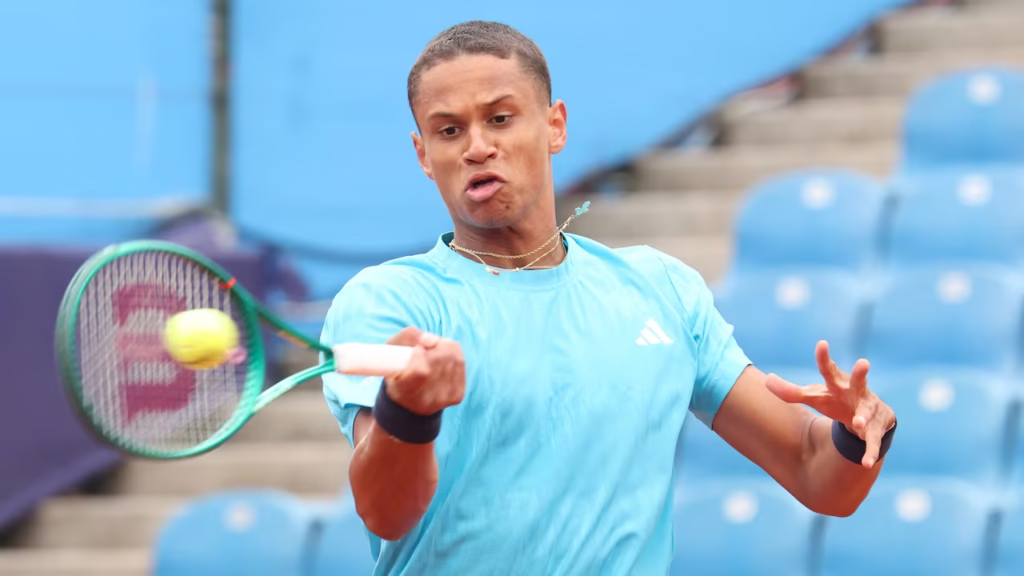
Alexander Zverev Powers Past Canadian Hope Diallo on Munich Clay
The picturesque backdrop of the MTTC Iphitos complex in Munich provided the stage for a classic clash of experience versus ambition at the BMW Open by American Express. In a match that underscored the relentless hierarchy of professional tennis, home favorite and top seed Alexander Zverev delivered a masterclass in clay-court efficiency, dispatching Canada’s Gabriel Diallo 6-1, 6-4. The straight-sets victory propels Zverev into the second round and sends a clear message about his form on the red dirt, while for Diallo, the encounter serves as a critical benchmark in his young career.
Home Soil Advantage: Zverev in His Element
There is a palpable comfort for Alexander Zverev when he competes in Germany, particularly on the clay of Munich where he has previously lifted the trophy. From the first ball strike, that familiarity was evident. The conditions—cool, heavy, and perfect for his brand of powerful, high-bouncing tennis—seemed tailor-made. Zverev, a former world number two and a constant threat on clay, utilized every inch of his experience to impose his will.
A First-Set Demolition
The opening set was a brutal display of Zverev’s baseline dominance. His game plan was executed with pinpoint precision:
- Relentless Depth and Power: Zverev struck his groundstrokes, particularly his fearsome two-handed backhand, with deep, penetrating intent. This consistently pushed Diallo meters behind the baseline, robbing him of any opportunity to dictate play.
- Impenetrable Serving: The German’s first serve was a weapon from the outset. He won a high percentage of points behind it, allowing him to hold serve comfortably and maintain relentless pressure on Diallo’s service games.
- Early Break, Immediate Control: Securing an early break, Zverev raced to a 4-0 lead, effectively extinguishing any early-match nerves or potential momentum for the Canadian. The set was over in a swift 27 minutes, a statement of intent to the rest of the draw.
Diallo’s Valiant Response and Lessons Learned
For Gabriel Diallo, the 6’8” rising star from Montreal, the match presented the steepest of challenges: facing a seasoned top-tier opponent in his own backyard on his favorite surface. The gulf in ATP Tour-level clay-court experience was significant, and the first set reflected that. Diallo’s massive serve, a key weapon on faster surfaces, was somewhat neutralized by the slow clay and Zverev’s elite return positioning.
However, to his immense credit, Diallo did not capitulate. The second set revealed the resilience and raw talent that has many marking him as Canada’s next major hopeful.
Finding a Foothold in the Fight
Adjusting his tactics, Diallo began to find more rhythm. His serve started to click, and he showed flashes of the powerful forehand that can dominate rallies. He matched Zverev hold-for-hold deep into the second set, reaching 4-4 and demonstrating that he could weather the storm and compete at this level. This period of the match was crucial, highlighting not just his power, but his growing competitive maturity.
- Improved First-Serve Percentage: Diallo began landing more first serves, giving him a platform to start points more aggressively.
- Willingness to Engage in Rallies: He settled into longer exchanges, showing he could trade blows from the baseline, even against one of the best.
- Mental Fortitude: Shaking off a lopsided first set to compete fiercely in the second is a testament to his mental toughness, a non-negotiable trait for future success.
Yet, the defining lesson came at the most crucial moment. At 4-4, Zverev’s elite quality shone through. He raised his intensity, conjured a series of punishing returns and passing shots, and secured the decisive break. It was a stark reminder that at the highest level, the very best find a way to seize their opportunities. Zverev then calmly served out the match, closing the door on any thought of a comeback.
Tactical Breakdown: Why Zverev’s Game is Built for Clay
This match was a perfect illustration of why Alexander Zverev is considered a perennial contender at the Masters 1000 and Grand Slam level on clay. His game is constructed for the surface’s unique demands.
- Movement and Court Coverage: For a man standing 6’6”, Zverev’s lateral movement and ability to slide into shots is exceptional. He covered the court effortlessly, negating Diallo’s attempts to hit through him.
- Heavy, Kicking Serve: His ability to drag opponents wide on the ad court with a heavy kick serve opens up the entire court for his first groundstroke.
- The Backhand Down-the-Line: This is perhaps his most devastating shot on clay. It allows him to change direction of the rally instantly and attack from defensive positions, a key weapon against taller players like Diallo who prefer to set up in the backhand corner.
- Patience and Point Construction: Unlike on hard courts, Zverev displayed patience, willing to construct points over multiple shots, waiting for the right moment to unleash his power or approach the net.
What This Means for Both Players’ Seasons
For Alexander Zverev: Momentum on the Road to Paris
This victory is more than just a first-round win at a 250-series event. For Zverev, performing well in Germany carries emotional weight and is a vital step in his clay-court rhythm. Building match wins and confidence in Munich is the ideal springboard for the grueling tests ahead in Madrid, Rome, and ultimately, Roland-Garros. A deep run or title here reaffirms his status as one of the men to beat on the surface and solidifies his momentum heading into the heart of the season.
For Gabriel Diallo: Invaluable Experience in the Climb
While the result is a loss, the experience for Gabriel Diallo is immeasurably valuable. Facing a player of Zverev’s caliber exposes the minute details that separate the top 10 from the rest of the tour:
- The consistency of depth under pressure.
- The tactical flexibility within a match.
- The ability to execute a game plan for every single point.
This match is a data point, a learning experience that will inform his training. His ability to adjust and compete in the second set is a positive takeaway he can build upon. The challenge now is to take these lessons into the next tournament, whether on the ATP Tour or Challenger circuit, and continue his upward trajectory.
Conclusion: A Showcase of Present Power and Future Promise
The 2024 BMW Open in Munich witnessed a match that encapsulated the narrative of modern tennis. In one corner, Alexander Zverev, the established superstar, used every ounce of his skill and experience to navigate a potentially tricky opener with commanding authority. His performance was a reminder of his clay-court pedigree and his serious ambitions for the coming weeks.
In the other, Gabriel Diallo, the promising talent, faced the fire of top-tier competition and, after initial shock, showed the resilience and tools that suggest a bright future. His journey is just beginning, and battles like this one are essential steps in the arduous climb up the ATP rankings.
For the Munich fans, they saw their hero advance convincingly. For the neutral tennis observer, they witnessed the compelling, cyclical nature of the sport—where today’s master hands the lesson to tomorrow’s contender. All eyes now turn to Zverev’s next match as he continues his quest for another Bavarian title, while Diallo’s path forward, armed with new experience, continues with great promise.