Canadian Artist Restores Priceless Paintings Amid Lebanon’s War
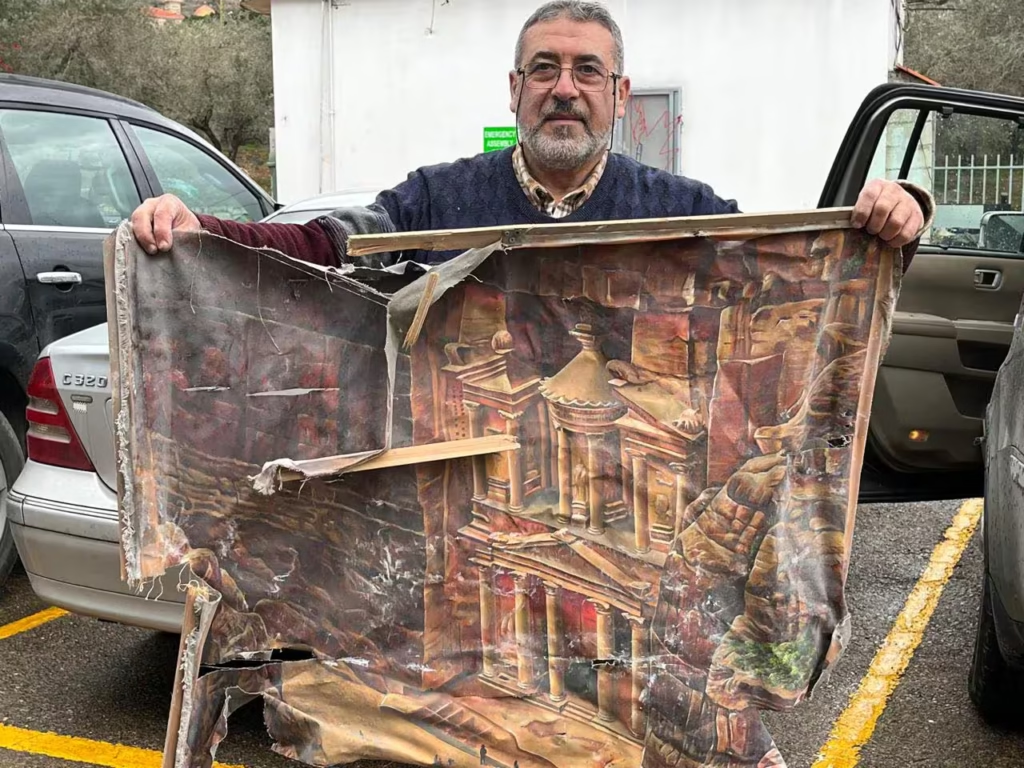
In a world often defined by what is destroyed, there are those who dedicate themselves to preservation. In the heart of Beirut, Lebanon, a nation perpetually balanced between hope and hardship, a Canadian artist is engaged in a quiet, profound act of defiance. Amidst the cacophony of economic collapse, political instability, and the echoes of regional conflict, she is not fleeing. She is restoring.
This is the story of a guardian of beauty, a Canadian conservator who has chosen to stand her ground, using her expertise to protect Lebanon’s priceless artistic heritage from the ravages of time and war. Her workshop is a sanctuary, her tools are her weapons, and her mission is clear: to ensure that when the dust settles, the soul of the nation, as captured on canvas, remains intact.
A Calling Forged in Crisis
The journey to becoming a restorer of Lebanon’s artistic legacy was not a straight path. Trained in the meticulous science and art of conservation, the artist returned to her roots in Lebanon with a vision. She established a studio dedicated to the delicate work of restoring paintings, from family heirlooms to national treasures housed in museums and cultural institutions.
However, the backdrop to this painstaking work has been one of escalating crisis. Lebanon’s severe economic depression, one of the worst in modern history, has been compounded by the devastating Beirut port explosion in 2020 and the ever-present threat of regional conflict spilling over its borders. For many, the choice has been to leave. But for this conservator, the work became more urgent, not less.
“When everything around you is falling apart, holding onto your culture, your history, becomes an act of resistance,” she explains. The paintings on her easel are not just objects; they are witnesses to history, vessels of memory, and testaments to a rich cultural identity that persists despite the chaos.
The Delicate Dance of Restoration in a War Zone
Conservation is a profession that demands precision, a controlled environment, and patience. War provides the exact opposite: uncertainty, vibration from explosions, power outages, and scarcity of materials. The artist’s daily reality is a masterclass in adaptation.
Overcoming Unimaginable Obstacles
Her work is defined by a series of constant challenges:
- Material Scarcity: Importing the specialized solvents, varnishes, and supports needed for professional restoration is often impossible due to banking collapses and import restrictions. She has become an expert in sourcing local alternatives and improvising solutions without compromising ethical standards.
- Power and Environment: The unreliable electricity grid means climate control—vital for stabilizing paint layers—is a constant battle. Generators hum in the background, and delicate procedures are planned around the schedule of daily power cuts.
- The Psychological Weight: The stress of working under the threat of violence is immense. The sound of distant explosions causes a dual reaction: a personal flinch, followed by an immediate professional assessment of the vibration’s potential impact on the fragile artworks in her care.
Yet, within the walls of her studio, a sacred silence prevails. Here, under the focused light of her lamp, time slows down. The process is meditative: carefully removing discolored varnish, consolidating flaking paint with a microscopic syringe, inpainting losses with reversible pigments. It is a dialogue with the original artist, a promise to honor their intent across the decades.
“I’m Still Standing”: Art as an Act of Defiance
The phrase “I’m still standing” is more than a personal mantra for this artist; it is the core philosophy of her mission. Each restored painting is a symbol of resilience. For the families who bring in portraits of their ancestors, the restoration is about preserving their lineage. For the nation, it is about safeguarding its collective identity.
She works closely with Lebanon’s national museum and other institutions, often on a pro-bono or reduced-cost basis, understanding that public funds for culture have evaporated. These paintings are not mere decorations; they are foundational documents. A restored landscape captures a Beirut skyline that no longer exists. A portrait preserves the likeness of a thinker, poet, or leader whose ideas still resonate. This work sends a powerful message: our story is worth saving.
The Ripple Effect of Preservation
The impact of this work extends far beyond the frame. By taking on apprentices and interns, the Canadian conservator is planting seeds for the future. She is training the next generation of Lebanese conservators, passing on not only technical skills but also this ethos of cultural stewardship. She is building a network of resilience, ensuring that the knowledge required to protect the nation’s heritage does not vanish.
Furthermore, her studio has become an unexpected hub for a community of artists, historians, and ordinary citizens. In a place where people feel powerless against macroeconomic forces and geopolitical tides, bringing a damaged painting to be restored becomes a tangible, hopeful act. It is a statement that they, too, are investing in what endures.
A Beacon of Hope for Global Cultural Heritage
The story of this Canadian artist in Lebanon is a microcosm of a global struggle. From Ukraine to Syria, Yemen to Afghanistan, cultural heritage is on the front lines. Her work underscores a critical truth: protecting art is not a luxury for peaceful times. It is a vital component of human dignity and a cornerstone for future recovery.
Her perseverance offers a blueprint for how specialized skills can be deployed as a force for stability. It demonstrates that the international art community has a role that extends beyond galleries and auctions—it can be a partner in active, on-the-ground preservation in crisis zones.
As the sounds of conflict occasionally pierce the calm of her studio, she continues her meticulous work. With each careful stroke, she is doing more than fixing cracks in paint. She is mending cracks in history. She is proving that in the face of overwhelming destruction, the most powerful reply is not a shout, but the quiet, unwavering focus of a restorer’s hand, ensuring that beauty, and the memory it holds, remains unbroken and undefeated.