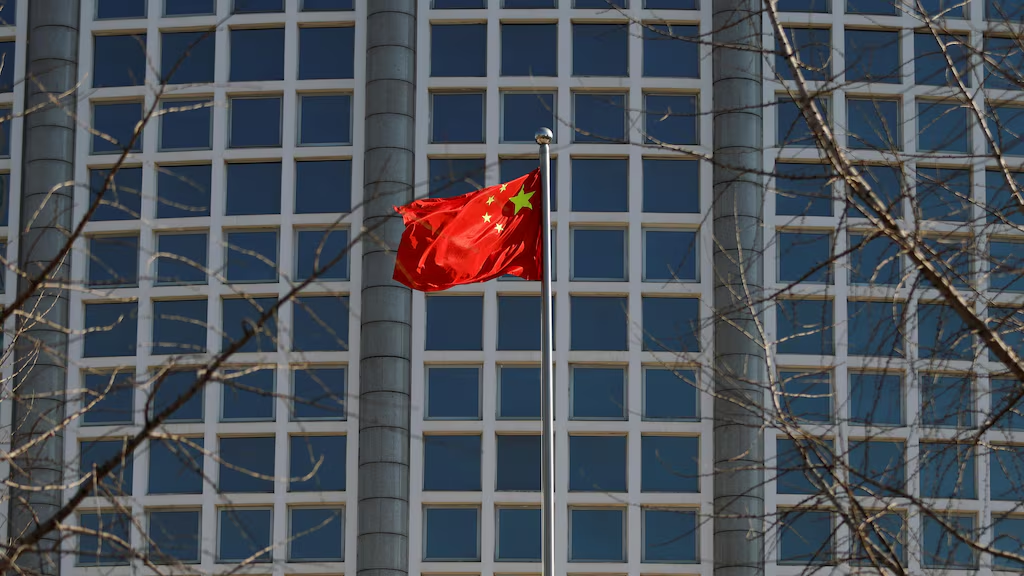
Canada’s Spy Agency CSIS Accuses China of Targeting Canadians and Stealing Technology
In a stark escalation of diplomatic tensions, the Canadian Security Intelligence Service (CSIS) has publicly accused China of orchestrating a multi-pronged campaign against Canadian citizens and national interests. The agency’s latest assessment, reported by WION, alleges that Beijing is not only engaging in systematic harassment of the Chinese-Canadian diaspora but also actively stealing sensitive technology from Canadian firms and research institutions. This revelation marks one of the most direct intelligence-led accusations leveled by Ottawa against Beijing in recent years, carrying profound implications for bilateral relations, national security policy, and the safety of Canadians abroad.
As a former intelligence analyst specializing in Asia-Pacific security dynamics, I can confirm that such a public attribution by a Western spy agency is rare. CSIS typically operates in the shadows; when it goes public, it signals that the threat is both credible and urgent. The allegations, if substantiated, represent a coordinated state-sponsored effort that goes far beyond traditional espionage.
The Core Allegations: A Three-Pronged Threat
According to the CSIS report, the Chinese government’s activities in Canada fall into three distinct but interrelated categories:
- Targeting of Canadian Citizens: Chinese state actors are allegedly surveilling, intimidating, and harassing Canadian citizens—particularly those of Chinese descent—who are perceived as critical of Beijing. This includes academics, journalists, and community leaders.
- Harassment of the Diaspora: Beyond individual targeting, the agency claims China is running a systematic campaign to silence dissent within the Chinese-Canadian community, using consular channels, business networks, and even family ties in China to apply pressure.
- Technology Theft: CSIS warns that Chinese intelligence operatives are actively stealing intellectual property from Canadian companies in sectors like artificial intelligence, quantum computing, and clean energy—often through joint ventures, cyber intrusions, or the recruitment of insiders.
These are not separate operations, but parts of a unified strategy that blends espionage, coercion, and influence. The Canadian government has long suspected such activities, but this is the first time CSIS has laid out the accusations in such granular detail.
Context: A Deteriorating Canada-China Relationship
To understand the gravity of this CSIS report, one must look at the broader trajectory of Canada-China relations. Since the 2018 arrest of Huawei executive Meng Wanzhou and the subsequent retaliatory detention of Canadian citizens Michael Kovrig and Michael Spavor, bilateral ties have plummeted to historic lows. The two Michaels were only released in 2021 after a political deal, but trust has not been restored.
In the years since, Canada has taken a harder line on Chinese influence operations. It expelled Chinese diplomats over allegations of intimidation against a Conservative MP, and it participated in multinational efforts to curb technology transfers to China. The CSIS allegations now provide an intelligence foundation for these political moves—and they suggest the threat has expanded in scope.
“The Chinese government views the Chinese-Canadian community not as a bridge but as a lever,” notes Dr. Sarah Lin, a professor of international security at the University of Toronto. “By targeting individuals who speak out, Beijing signals that no one is beyond reach. The tech theft component is equally alarming because it targets Canada’s future economic competitiveness.”
Why Now? The Timing of the Public Disclosure
Intelligence agencies rarely release such detailed public briefings without a strategic rationale. Three factors likely drove CSIS to break its silence:
- Deterrence: By naming the threat publicly, Ottawa hopes to disrupt Chinese operations. Targets become more alert, and potential sources inside Canada may reconsider cooperating with foreign intelligence.
- Legitimacy: The allegations strengthen the Canadian government’s hand in imposing new sanctions or export controls on Chinese entities. A public intelligence report provides legal and political cover for tougher measures.
- Alliance Cohesion: Canada is aligning with Five Eyes partners—the US, UK, Australia, and New Zealand—who have all raised similar concerns about Chinese coercion and tech theft. This report is a signal of solidarity.
Critically, the timing also coincides with increasing scrutiny of Chinese influence in Western democracies ahead of upcoming elections. Canada’s next federal election is due in 2025, and the government is keen to demonstrate that it is actively countering foreign interference.
Expert Analysis: Separating Rhetoric from Reality
While the CSIS allegations are serious, independent security analysts urge caution about over-interpreting the intelligence. Classified assessments often rely on sensitive sources and methods—human intelligence, signals intercepts, and open-source analysis—that cannot be independently verified. However, the consistency of the pattern with other Five Eyes nations lends credibility.
“We have seen nearly identical language from the Australian Security Intelligence Organisation (ASIO) about Chinese interference in their academic institutions, and from MI5 about Chinese tech theft in the UK,” says retired Canadian intelligence officer Mark Tremblay. “This is not a rogue Canadian report. It is a consensus view within the intelligence community.”
What is new, Tremblay adds, is the explicit focus on the diaspora. Previous reports have concentrated on government diplomats and business elites. CSIS now says the net is cast much wider, targeting ordinary Canadians who advocate for human rights in Xinjiang, Tibet, or Hong Kong.
Technology Theft: The Silent Drain
The subset of allegations regarding intellectual property theft deserves special attention. Canada has invested heavily in AI and quantum research, and Chinese state-owned enterprises have shown great interest in these fields. According to CSIS, Chinese spies have infiltrated start-ups through fake investment pitches, and they have used cyberattacks to exfiltrate proprietary data from university labs.
One troubling example cited in the report involves a British Columbia-based clean energy firm. Chinese-linked operatives allegedly attempted to recruit an engineer by offering lucrative positions in Shenzhen—a classic “brain drain” technique. When the engineer refused, his family in China was reportedly pressured. Such coercive recruitment tactics blur the line between economic espionage and human rights violations.
The economic cost is difficult to quantify, but a 2023 study by the Canadian Chamber of Commerce estimated that intellectual property theft costs the Canadian economy between $20 billion and $30 billion annually. A significant portion of that is attributed to state-sponsored actors.
What Comes Next? Policy Implications
The CSIS report is unlikely to be a one-off. Expect a flurry of follow-up actions from the Canadian government:
- Enhanced Screening: Tighter visa requirements for Chinese nationals involved in sensitive research fields, and stricter scrutiny of joint ventures.
- Sanctions Regime: Ottawa may add new Chinese entities to its sanctions list under the Special Economic Measures Act, particularly those linked to technology theft.
- Diaspora Outreach: The government will likely fund community programs to help Chinese-Canadians report intimidation, and strengthen consular services for Canadians in China.
- Legislative Changes: A new foreign interference registry—similar to the U.S. Foreign Agents Registration Act—could be introduced to increase transparency in Chinese-backed lobbying.
However, there is a risk of overreaction. Some critics argue that publicly naming China risks stigmatizing the entire Chinese-Canadian community, which numbers over 1.8 million people. As Dr. Lin notes, “The problem is not Chinese culture or Chinese people. It is the CCP’s authoritarian apparatus. We must be careful not to conflate the two.”
Conclusion: A New Normal in Canada-China Relations
The CSIS accusations have fundamentally altered the public narrative around Canada’s relationship with China. For years, the conversation was dominated by trade and investment. Now, the focus is squarely on security, coercion, and espionage. The intelligence community has drawn a line in the sand, and it is up to politicians to decide how to respond.
For Canadian citizens—particularly those in the diaspora—the warning is chilling. The government is essentially saying that Beijing may be watching you, and that you could become a target simply for exercising your free speech. For the Canadian tech sector, the message is equally stark: your intellectual property is being actively looted, and traditional defenses are not enough.
This is not a short-term crisis. It is the opening of a new chapter in great-power competition, playing out not only in boardrooms and intelligence briefings but in the everyday lives of ordinary Canadians. The CSIS report serves as a wake-up call—one that demands vigilance, resilience, and a clear-headed understanding of the threats that lie ahead.