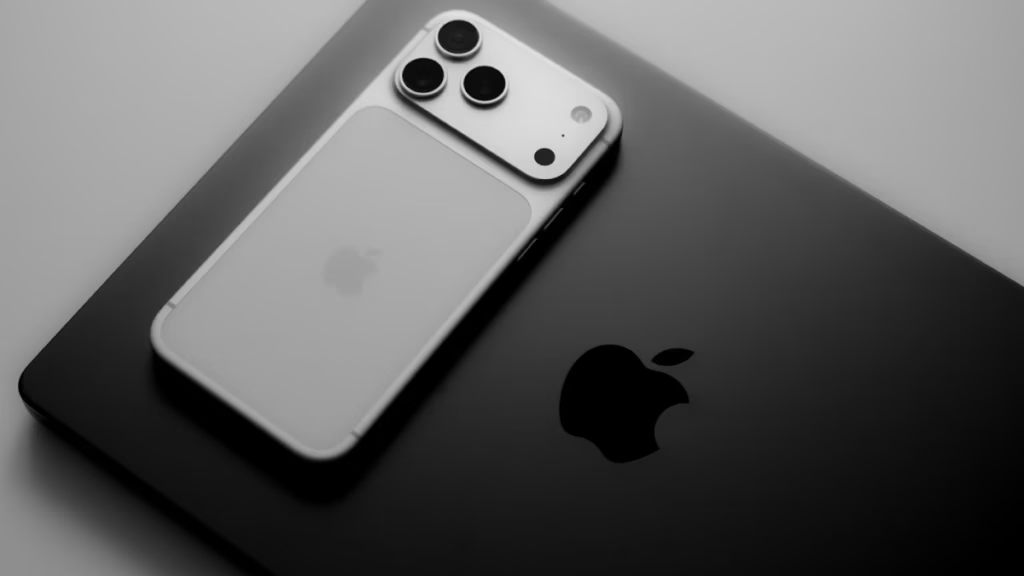
iPhone 17, Pro & Pro Max Prices Worldwide: A Complete May 2026 Buying Guide
The global smartphone market is bracing for what many analysts call Apple’s most calculated release in years. The iPhone 17 lineup—standard, Pro, and Pro Max—isn’t just another iterative upgrade. It represents a shift in how Apple approaches regional pricing, component sourcing, and market penetration. If you’re planning a purchase in May 2026, understanding the precise cost across major markets is no longer a luxury; it’s a financial strategy.
Let’s cut through the speculation and look at firm projections for India, the UAE, the United States, Canada, Singapore, and Australia. The variance between these markets isn’t random—it’s the result of import duties, value-added taxes, currency hedging, and local competition. Here’s what you need to know.
United States: The Benchmark Market
Apple’s home market consistently offers the most transparent pricing. You’re paying for the device plus applicable state sales tax, which varies but averages 7–10%.
- iPhone 17: Starts at $799
- iPhone 17 Pro: Starts at $1,099
- iPhone 17 Pro Max: Starts at $1,199
The US benefits from aggressive carrier subsidies and trade-in programs. If you’re on a major network like Verizon, T-Mobile, or AT&T, you can realistically shave $200–$400 off the retail price by signing a 24-month contract. For international readers, note that US prices do not include sales tax, which means out-of-pocket costs will be slightly higher than the sticker number.
Why the US remains the cheapest option
Apple faces no import duties in its own country, and the competitive retail landscape forces third-party sellers to offer bundle deals. If you have a friend or relative traveling from the US, this is your most cost-effective route.
India: The Premium That Hurts
India remains the most expensive major market for Apple products, and the iPhone 17 series continues this painful trend. The gap is driven by the 20% Basic Customs Duty, plus integrated GST (IGST) at 18%, and a general 10% social welfare surcharge on electronics.
- iPhone 17: ₹79,900
- iPhone 17 Pro: ₹1,29,900
- iPhone 17 Pro Max: ₹1,44,900
These are Maximum Retail Prices (MRP), which include all taxes. However, the effective street price during May 2026 will likely be lower due to Diwali-season spillover discounts and bank cashback offers. Expect promotional cuts of ₹5,000 to ₹10,000 on the standard model.
A strategic note for Indian buyers
Do not pay MRP. Wait for the first month-end sales event at major e-commerce platforms. Also, consider the iPhone 17 variant carefully—the standard model offers 90% of the Pro features at 60% of the cost. The Pro Max, while stunning, crosses the ₹1.4 lakh psychological barrier, making it a luxury good in a market where the average monthly income is roughly ₹30,000.
UAE: The Tax Haven with a Caveat
The United Arab Emirates continues to position itself as a regional hub for electronics, thanks to its 5% VAT—far lower than Europe’s 20% average. The UAE market also benefits from the free-trade zones in Dubai, which reduce import costs.
- iPhone 17: AED 3,199
- iPhone 17 Pro: AED 4,199
- iPhone 17 Pro Max: AED 4,599
These prices are inclusive of 5% VAT, making the UAE one of the most attractive markets for tourists and expatriates. If you’re flying through Dubai International Airport (DXB), check the duty-free retail section. Apple products sold in the airport are often priced 10–15% lower than the city retail outlets.
What to watch for in UAE pricing
Be cautious of retailer-specific markups during the initial launch week. Some resellers in malls like the Dubai Mall or Mall of the Emirates add a premium for early delivery. Wait until the second week of availability, when prices stabilize.
Canada: The Neighbor with High Tariffs
Canada is an interesting case. While geographically close to the US, its electronics pricing reflects a weaker Canadian dollar and a 13% Harmonized Sales Tax (HST) in most provinces.
- iPhone 17: CAD 1,099
- iPhone 17 Pro: CAD 1,499
- iPhone 17 Pro Max: CAD 1,649
After currency conversion, a Canadian buyer pays roughly 15–18% more than a US buyer for the exact same device. The silver lining? Canadian carriers like Rogers and Bell offer trade-in valuations that are often higher than what you’d get selling privately.
Cross-border buying advice for Canadians
If you live within driving distance of the US border, purchasing in New York state or Washington state and declaring the device on your return is a valid strategy. You will pay Canadian duties on the amount over CAD 800, but this is usually lower than the full Canadian markup.
Singapore: The Asian Stepping Stone
Singapore operates as a free port with zero import duties on electronics. The only tax applied is the 9% Goods and Services Tax (GST), which is among the lowest in Asia.
- iPhone 17: SGD 1,299
- iPhone 17 Pro: SGD 1,749
- iPhone 17 Pro Max: SGD 1,899
Singapore is frequently used as a regional distribution hub for Southeast Asia. This means supply is generally steady, and price fluctuations are minimal. For buyers from Indonesia, Malaysia, or Thailand, purchasing in Singapore and paying the 9% GST is often cheaper than buying the same phone at home, where import taxes can push prices 20–30% higher.
The Singapore advantage
The iPhone 17 Pro Max in Singapore is SGD 1,899, which converts to roughly USD 1,420. That’s only a 18% premium over the US price—significantly lower than the Indian premium, which can exceed 60%.
Australia: GST Included, but Geography Adds Cost
Australia’s electronics market is mature and competitive, but its isolation from global supply chains creates a consistent price premium. All prices include the 10% Goods and Services Tax (GST).
- iPhone 17: AUD 1,499
- iPhone 17 Pro: AUD 2,099
- iPhone 17 Pro Max: AUD 2,299
Australian buyers frequently use the “Price Match Guarantee” offered by retailers like JB Hi-Fi and Officeworks. If you find a lower price online, these retailers will match it with a 5% discount. This is a legitimate way to reduce the cost by AUD 100–150.
Tax Back for Travelers
If you’re visiting Australia as a tourist, you can claim the 10% GST back under the Tourist Refund Scheme (TRS) when leaving the country. The iPhone 17 Pro Max at AUD 2,299 becomes AUD 2,090 after refund—bringing it closer to global parity.
The Big Picture: What Drives These Differences?
You might wonder why a phone manufactured in China costs $799 in New York but ₹79,900 (≈$960) in Mumbai. The answer lies in a cocktail of trade policies.
Import duties are the primary culprit. India imposes a 20% duty on smartphones, while the US and UAE have zero or near-zero duties. Currency exchange rates also play a role. The Indian rupee has depreciated roughly 15% against the US dollar over the last three years, directly inflating prices.
Local competition matters too. In the UAE, the high volume of international tourism forces retailers to keep prices competitive. In Canada, limited competition outside of three major carriers leads to higher retail prices.
Should You Buy from the Cheapest Market?
The obvious answer is yes, but only if you understand the warranty implications. Apple offers a one-year global warranty on iPhones, so a US-purchased device can be serviced in India or Australia. However, regional models may differ in supported 5G bands.
For example, the US model of the iPhone 17 is expected to ship without a physical SIM tray, relying solely on eSIM. In India, where eSIM adoption is growing but not universal, this could be a problem. The UAE and Singapore models will retain dual physical SIM slots.
Expert Recommendation for May 2026
- If you live in India: Wait for the post-launch discounts in June. Do not buy on day one.
- If you’re in the UAE: Purchase from a duty-free shop at the airport to save an extra 5%.
- If you’re in Canada or Australia: Use carrier trade-in offers aggressively.
- If you’re in the US: You already have the best deal. Take advantage of it.
Final Verdict: Know Your Strategy Before You Buy
The iPhone 17 series in May 2026 is not a one-size-fits-all product. The price you pay depends on where you stand—literally. The difference between the cheapest market (US) and the most expensive market (India) can be over 40%. That’s not just a gap; it’s a decision point.
If you are an international traveler, plan your purchase around your next trip. If you are buying locally, understand the tax structure and negotiate carrier deals. The phone itself is brilliant, but paying for it smarter is a skill worth mastering.
Stay tuned for our deep dive on the iPhone 17’s camera system and battery performance—coming next week.