
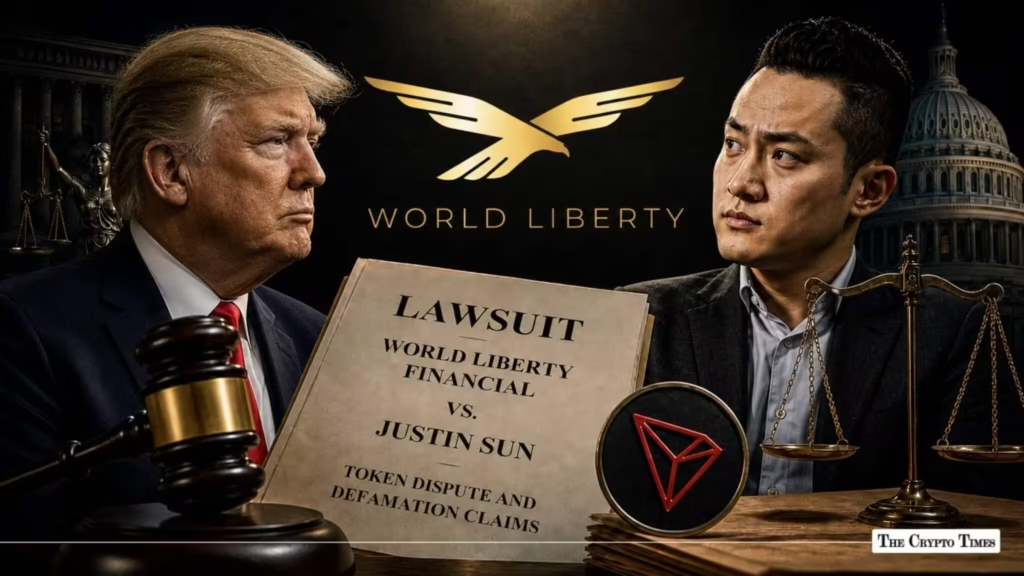
Trump-Backed Crypto Project World Liberty Financial Files Defamation Lawsuit Against Justin Sun
The intersection of politics, celebrity, and cryptocurrency has produced another headline-grabbing legal battle. World Liberty Financial (WLFI), a decentralized finance (DeFi) project closely tied to former President Donald Trump and his family, has filed a defamation and breach-of-contract lawsuit against Justin Sun, the high-profile founder of the Tron blockchain. The suit, lodged in a federal court in Florida, alleges that Sun made false and damaging statements that undermined the project’s integrity and financial viability. This case is not just a personal feud; it raises important questions about the boundaries of free speech in the crypto space and the legal responsibilities of influential figures when commenting on rival ventures.
The Genesis of the Conflict: World Liberty Financial and Justin Sun
To understand the lawsuit, we must first look at the players involved. World Liberty Financial launched in late 2024 with the explicit backing of the Trump family. The project’s goal was to create a borrowing and lending platform built on the Ethereum blockchain, with Donald Trump’s sons, Eric and Donald Trump Jr., serving as “Web3 ambassadors.” The token sale, however, has been a subject of intense scrutiny. While the project has raised some capital, it fell far short of initial expectations, selling only a fraction of its available tokens.
Justin Sun, the Chinese-born crypto entrepreneur known for flamboyant marketing and a history of regulatory run-ins (including with the U.S. Securities and Exchange Commission), was an early and controversial investor in WLFI. According to court documents, Sun agreed to invest $30 million in the project, but the relationship soured quickly. Sun later publicly criticized WLFI’s token sale, calling it a “failure” and suggesting that the Trump family had improperly profited from the venture. These statements, WLFI argues, crossed the line from opinion into defamation.
What Did Justin Sun Say? The Defamation Claims
The lawsuit centers on a series of statements Sun allegedly made on social media and in interviews. WLFI claims that Sun’s words were not only false but were deliberately crafted to damage the project’s reputation and drive away potential investors. Key points of contention include:
- Claim that the token sale was a “complete failure.” WLFI argues that while sales were lower than projected, the project remains operational and has a growing user base. Calling it a “failure” is an exaggeration that misleads the public.
- Allegations that the Trump family took personal profits from the token sale. WLFI insists that all proceeds were directed to the project’s treasury and that no family members received direct compensation from token sales.
- Statements implying that WLFI engaged in deceptive marketing. Sun allegedly suggested that the project misled investors about the role of the Trump family, which WLFI denies.
The legal filing describes Sun’s remarks as “malicious, false, and calculated to cause harm.” WLFI is seeking both compensatory and punitive damages, as well as a court order requiring Sun to retract his statements. Notably, the suit also alleges that Sun’s actions constitute a breach of contract—specifically, a confidentiality clause in his investment agreement that prohibited him from making negative public comments about the project.
Breach of Contract: The $30 Million Investment Angle
While defamation grabs the headlines, the breach-of-contract element adds a fascinating layer to the case. WLFI claims that when Sun invested $30 million, he signed an agreement that included a non-disparagement clause. Such clauses are common in high-stakes investment deals, particularly for early-stage projects that are vulnerable to negative publicity. If the court finds that Sun violated that clause, he could face financial penalties beyond the defamation claim.
Legal experts note that this dual approach—mixing defamation with contract law—is a strategic move. Proving defamation in court can be challenging, especially for public figures like the Trumps, who must often demonstrate “actual malice” (knowledge of falsity or reckless disregard for the truth). A breach-of-contract claim, however, has a lower bar: WLFI only needs to show that Sun agreed to not disparage the project and then did so, regardless of whether his statements were strictly true or false. This could give WLFI a powerful hammer in negotiations or at trial.
Implications for the Crypto Industry: A Precedent in the Making?
This lawsuit has implications that extend far beyond the Trump family and Justin Sun. The crypto world is awash with rival projects, influencers, and personalities who frequently trade barbs online. Most of these exchanges are dismissed as “market chatter,” but WLFI v. Sun could set a legal precedent that makes such commentary riskier.
Consider the following aspects:
- Free speech vs. financial harm. Courts have long struggled to balance free expression with the need to protect businesses from false statements. This case will test whether a public figure like Sun can be held liable for expressing a negative opinion about a token sale, even if that opinion is based on verifiable data (e.g., low sales figures).
- Confidentiality in crypto deals. Many crypto projects rely on NDAs to control their narrative. If the court upholds WLFI’s breach-of-contract claim, it will reinforce the enforceability of such clauses in the digital asset space, potentially chilling critical discussion among investors.
- Reputation management. For projects tied to controversial figures—like the Trump family—negative coverage can be amplified. This lawsuit sends a message that project founders are willing to use the legal system to defend their brand, even against high-profile critics.
Expert Analysis: Why This Case Demands Attention
As a legal and crypto analyst, I find this case particularly instructive because it highlights the growing maturity—and litigiousness—of the blockchain industry. A few years ago, such disputes would have played out entirely on Twitter. Today, parties are filing federal lawsuits. This shift reflects the massive sums of money at stake and the increasing recognition that defamation can cause quantifiable financial damage.
One critical factor to watch is the transparency of WLFI’s token sale data. If Sun’s statements about the sale being a “failure” are based on publicly available figures showing only a fraction of tokens sold, he may have a defense in that he was stating an opinion grounded in facts. However, if WLFI can prove that Sun selectively omitted information—such as the project’s ongoing development and partnerships—his “opinion” could be deemed misleading enough to constitute defamation.
Another key variable is the role of the Trump name. Courts often apply a higher standard for defamation when the plaintiff is a limited-purpose public figure. Because the Trumps have voluntarily entered the public sphere with their crypto project, they may be required to show that Sun acted with “actual malice.” That is a difficult standard to meet, which is why the breach-of-contract claim is so important for WLFI’s legal team.
Conclusion: A High-Stakes Battle for Reputation and Legal Boundaries
The lawsuit between World Liberty Financial and Justin Sun is more than a tabloid headline. It is a test case for how defamation and contract law apply in the rapidly evolving cryptocurrency ecosystem. Regardless of the outcome, both sides are signaling that they will fight hard—WLFI to protect its reputation and investment, and Sun to defend his right to criticize projects he deems mismanaged.
For investors and crypto enthusiasts, this case offers a valuable lesson: words have consequences, and in the world of digital assets, those consequences can land you in federal court. Whether you view WLFI as a legitimate DeFi project or a political marketing stunt, the legal principles at play here are serious and far-reaching. As the proceedings unfold, they will likely become a reference point for future disputes involving crypto influencers, early investors, and high-profile brands.

