
NAIT Carpentry Instructor Fuels Canada’s WorldSkills Comeback
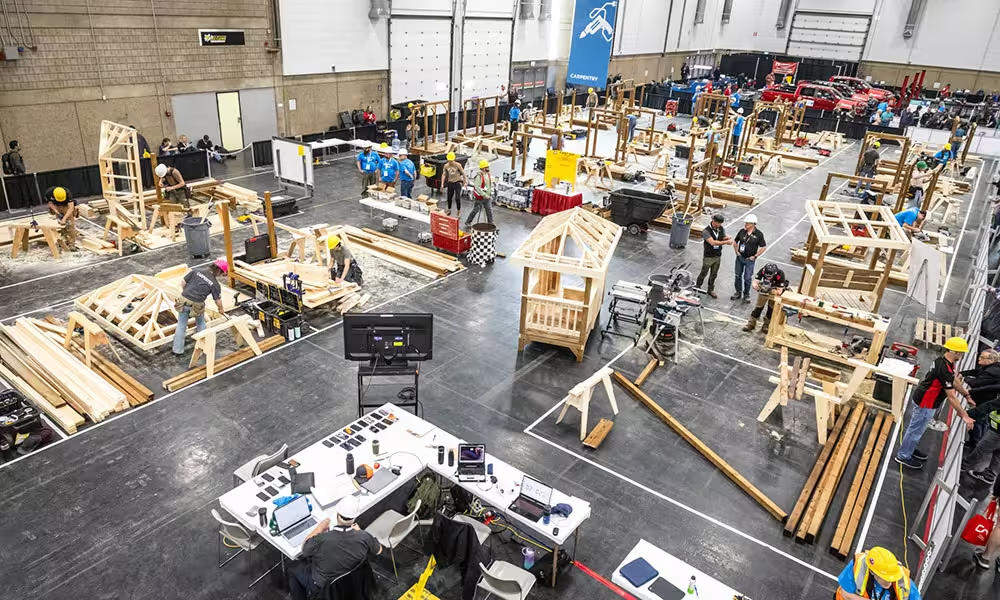
Every few seconds, a saw blade screams through pine. Chips fly. The clock ticks down. For Team Canada’s carpentry competitor at WorldSkills 2024, this wasn’t just another project—it was the moment four years of relentless training collided with two decades of international competition history.
And behind that moment stood one man: Lane Shishkin, a carpentry instructor at the Northern Alberta Institute of Technology (NAIT). His quiet, methodical approach didn’t just produce a medal—it rewrote the Canadian narrative on the global trades stage.
The Drought That Demanded a Different Approach
Before this year, Canada’s carpentry team had spent years watching other nations collect hardware. The last time a Canadian carpenter stood on a WorldSkills podium, smartphones were still a novelty. The gap wasn’t just about skill—it was about preparation philosophy.
Shishkin, himself a former WorldSkills competitor, knew the old model wasn’t working. Canadian carpenters were trained to build to North American standards—fast, functional, and tolerant of slight imperfections. But WorldSkills judges reward precision measured in millimeters, symmetrical perfection, and adherence to strict European joinery techniques that many Canadian apprentices rarely encounter.
So Shishkin did something radical: he tore down the training playbook and rebuilt it from the ground up.
Why This Comeback Is Different From Previous Attempts
The victory didn’t happen by accident. Shishkin introduced a training regimen that looked less like a classroom and more like an Olympic training camp. Here’s what changed:
Material Familiarity – European competition wood behaves differently than North American lumber. Shishkin sourced identical materials months in advance, forcing the team to learn the unique grain, humidity responses, and cutting behaviors of woods they’d never worked with before.
Time Compression Drills – Standard Canadian projects allow generous timelines. WorldSkills gives you two days to build a complex piece that most journeymen would take a week to complete. Shishkin ran simulated competitions that shaved 15 minutes off every deadline, training muscle memory under duress.
Judging Criteria Mapping – Instead of teaching general carpentry, Shishkin dissected past WorldSkills score sheets. Every tenth of a point was analyzed. Team Canada learned to prioritize the joints and finishes that carried the highest weight, even if those techniques felt unnatural at first.
The Human Element: Coaching Beyond the Blueprint
What separates a good instructor from a great one is the ability to read a competitor’s mental state. WorldSkills is not just a technical challenge—it’s a psychological pressure cooker. Competitors face judges who speak different languages, unfamiliar tools, and a crowd that amplifies every mistake.
Shishkin understood this intimately. During preparation, he introduced “crowd drills” where local students would gather around the workspaces, yelling and clapping, while the competitor had to maintain precision. He built resilience into the process, not as an afterthought, but as a core training pillar.
“It’s easy to be fast when no one is watching,” Shishkin told his team repeatedly. “It’s a different beast when the crowd is roaring.”
NAIT’s Role in the Resurrection
This victory doesn’t belong to Shishkin alone. It reflects a strategic investment by NAIT in trades excellence. The institution has become Canada’s de facto training ground for WorldSkills competitors across multiple disciplines, not just carpentry.
What makes NAIT different?
- Dedicated Competition Labs – Separate from regular classrooms, these labs are equipped with the exact tools and machinery used at WorldSkills events, eliminating the surprise factor.
- Cross-Trade Collaboration – Carpentry students work alongside electricians and millwrights, learning how different trades interact in a competition environment—a skill that directly translated to the team challenges.
- Instructor Ties to Industry – Shishkin and his colleagues maintain active connections with commercial construction firms, ensuring training reflects real-world demands, not just academic theory.
When Canadian carpentry needed a home base, NAIT provided more than space—it provided a culture that treats competition preparation as a legitimate academic pursuit.
What This Win Means for Canadian Trades
The ripple effects extend far beyond a single medal. Canada faces a skilled labor shortage of alarming proportions. Trade schools across the country struggle to attract young people who still view carpentry as a “backup plan” rather than a prestigious career.
Stories like this change that narrative.
When a NAIT instructor leads a national team back to the podium, it sends a message to high school students, parents, and guidance counselors: Canadian trade education is world-class. It tells young carpenters that their craft is respected on an international stage, and that with the right training, they can compete—and win—against the best in the world.
Shishkin himself has become an unlikely celebrity in trade circles. He now receives invitations to speak at conferences, consult with other colleges, and mentor future competitors. But he remains grounded. His office at NAIT still smells like sawdust. His hands still show calluses from working alongside students.
The Road Ahead: Sustaining the Momentum
One comeback doesn’t fix a systemic problem. Shishkin and NAIT are already looking toward the next WorldSkills cycle. The goal is no longer just to win—it’s to build a pipeline that consistently produces medal-worthy competitors.
Plans include:
- A national carpentry scouting network to identify promising apprentices earlier
- Virtual reality training modules that simulate competition conditions
- Partnerships with European trade schools to exchange coaching techniques
If this year proved anything, it’s that Canada no longer has to play catch-up. With instructors like Lane Shishkin and institutions like NAIT willing to invest in excellence, the standard has been reset.
A Final Word on Craft and Character
The tools change. The wood changes. The judges change. But what remains constant is the relationship between a master and an apprentice. In a world obsessed with automation and AI, this WorldSkills victory reminds us that skilled trades are still fundamentally human endeavors.
Lane Shishkin didn’t just teach a student how to cut a dovetail joint. He taught him how to remain calm when a 360-degree joint needed to hold under inspection. He taught him that perfection isn’t about avoiding mistakes—it’s about recovering from them in under thirty seconds.
That’s the difference between a carpenter and a champion. And that’s why Canadian carpentry is finally back on the WorldSkills podium.