Canada Marks Sixth National Truth and Reconciliation Day
On September 30, leaders and survivors gathered to reflect on residential schools, with PM Carney emphasizing that reconciliation remains incomplete after 11 years.
National Day for Truth and Reconciliation
A Journey That Remains Unfinished
On Wednesday, September 30, Canadians marked the sixth National Day for Truth and Reconciliation—a date set aside each year to remember the devastating legacy of residential schools and the ongoing work required to heal from that history. Prime Minister Mark Carney addressed crowds in Edmonton, delivering a sobering message: the effort to come to terms with Canada’s past may never truly finish.
Standing before an audience that included Indigenous children and their families, Carney framed reconciliation not as a goal to be reached but as a continuous process. He acknowledged that wounds run deep and gaps remain wide, urging Canadians to move “as far and as fast down the path as we can” together.
What Residential Schools Were and Why This Day Exists
Canada’s residential school system operated from 1857 to 1996—nearly 140 years during which approximately 150,000 Indigenous children were forcibly removed from their families and placed in government or church-run institutions. These facilities were deliberately designed to assimilate Indigenous youth by severing their connections to languages, cultures, identities, and traditional ways of life.
The Truth and Reconciliation Commission’s exhaustive study revealed the devastating human cost: widespread abuse, neglect, malnutrition, disease, and an estimated 6,000 deaths. The intergenerational trauma resulting from these policies continues to affect Indigenous communities today. In 2015, when the TRC released its final report, it issued 94 calls to action—concrete recommendations for federal, provincial, and territorial governments to implement in order to address the harms and move toward genuine reconciliation.
The National Day for Truth and Reconciliation was established to ensure that Canadians pause each year to remember this history and recommit to the work ahead.
Progress Stalled: Only 15 of 94 Calls to Action Implemented
Eleven years after the TRC report was published, only 15 of its 94 calls to action have been put into force. This stark figure underscores why Carney and other leaders continue to emphasize that the work is far from complete.
Residential school survivor Eugene Arcand spoke to CBC News on Parliament Hill, noting that the National Day sometimes forces Canadians to confront “complacency” that has set in since the report was published. Arcand highlighted what many survivors see as unfinished business in addressing even basic cooperation and understanding of the calls to action.
Carney acknowledged in his statement that survivors deserve more than remembrance alone. The government, he said, owes them action—and the 94 calls remain a roadmap for that work.
Governor General’s Message: Truth as Foundation
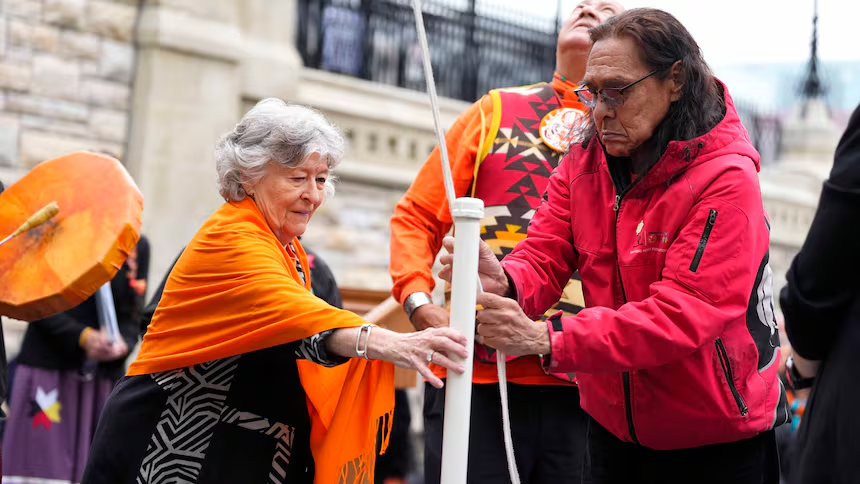
Governor General Louise Arbour observed her first National Day for Truth and Reconciliation by participating in the re-raising of the Survivors’ Flag ceremony on Parliament Hill in Ottawa. She spoke of the necessity of facing difficult truths as a prerequisite for building a better country.
Arbour explained that while truth cannot change the past, it carries responsibility. That responsibility includes recognizing injustices, learning from them, and ensuring they never happen again. She characterized the Survivors’ Flag as both a warning and a symbol of hope—representing what was lost, but also what endured and continues to thrive within Indigenous communities despite immense hardship.
She called on all Canadians to listen with open hearts during the National Day, inviting them to reflect on experiences shared by survivors and their families.
Federal Accountability and Government Responsibility
Carney’s statement was explicit about federal responsibility. The Canadian government established and sustained the residential school system, and therefore Canada bears accountability for the profound and enduring harm it caused. This acknowledgment of direct government role distinguishes recent messaging from earlier approaches that sometimes deflected responsibility to churches or portrayed the system as a historical aberration rather than deliberate policy.
The Prime Minister’s framing of reconciliation as an “attitude, not an achievement” and a “journey, not a destination” reflects a shift in how federal leadership discusses this work. Rather than promising a definitive endpoint, the language emphasizes ongoing commitment and continuous reflection.
Opposition Leaders Weigh In
Conservative Leader Pierre Poilievre characterized residential schools as “a massive intrusion of government coercion” that removed children from parents and communities while attempting to sever their connection to identity. He called for reconciliation built on self-determination, opportunity, and true partnership.
NDP Leader Avi Lewis took a different angle, emphasizing the urgency of government action. He stated that the long-unfinished 79 calls to action from the TRC report require immediate attention, framing implementation as overdue rather than ongoing.
What Survivors and Communities Are Saying
Beyond official statements, the voices of survivors themselves remain central to understanding what this day means. Arcand’s observation about complacency reflects frustration among many survivors that annual remembrance has not translated into systemic change. While media coverage, flag-raising ceremonies, and official addresses create visibility, the gap between acknowledgment and action remains the most pressing concern for those who lived through the schools or whose families were affected.
The fact that nearly 40,000 residential school records are slated for destruction—despite objections from some survivors—further illustrates tensions between memorial practices and concrete support for ongoing investigation and accountability.
Looking Forward: What Needs to Happen Next
The sixth National Day for Truth and Reconciliation arrives at a critical juncture. With only 15 of 94 calls to action implemented after 11 years, the pace of change falls far short of what survivors and Indigenous leaders describe as necessary. The remaining 79 calls touch on areas ranging from education reform and health services to justice system changes and cultural recognition.
For Canadians observing this day, the key takeaway is clear: remembrance without action is insufficient. The work ahead requires sustained commitment from all levels of government, institutions, and individual Canadians to move beyond reflection and toward the systemic changes outlined in the TRC’s roadmap.
Mark this date on your calendar each year and ask yourself: What concrete action am I taking or supporting to advance reconciliation? That question, asked widely and answered earnestly, may be the measure of whether Canada’s commitment is genuine.