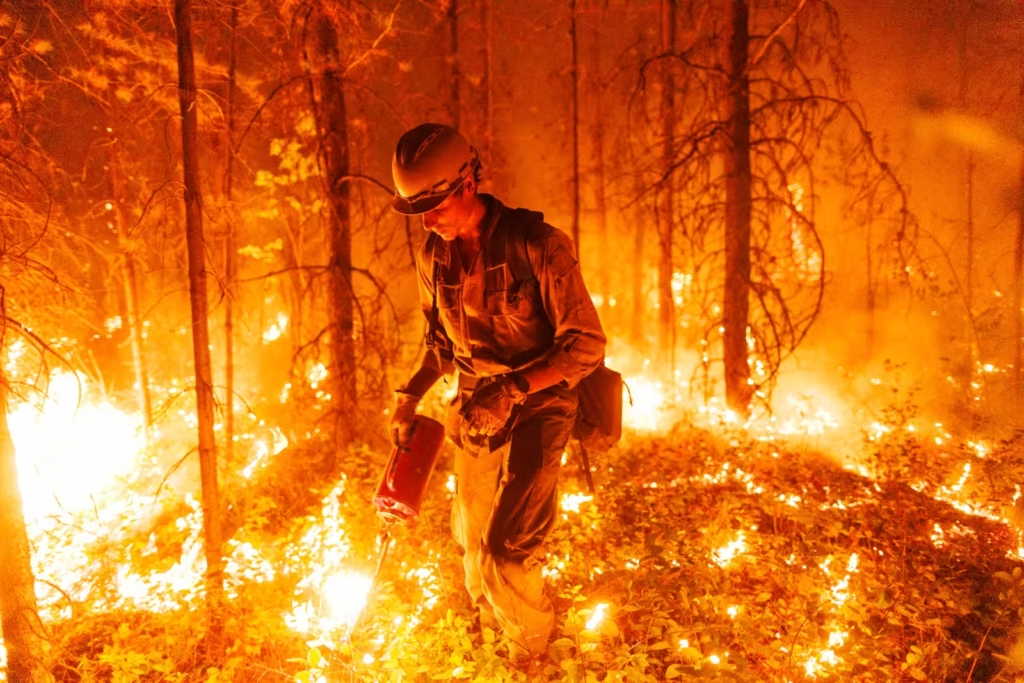
How B.C. Is Using AI to Predict and Prevent Lightning Wildfires
Dry lightning has long been one of the most unpredictable wildfire threats in British Columbia. Unlike human-caused fires, which are often reported quickly near populated areas or highways, lightning-ignited fires can start deep in remote forests and burn undetected for hours — or even days — before crews are able to respond.
British Columbia is now using artificial intelligence to change that equation. The province is deploying advanced AI technology designed to predict which lightning strikes are most likely to ignite wildfires, allowing firefighters to respond faster and more strategically before small fires grow into major disasters.
This is more than a simple upgrade to weather forecasting. It represents a major shift in how wildfire risk is analyzed, how firefighting resources are deployed, and how prevention efforts are managed across the province.
The Science Behind the Technology
Traditional wildfire prevention relies heavily on satellite imagery, weather forecasts, historical fire patterns, and reports from lookout towers or aircraft patrols. After a lightning storm, wildfire officials often have to determine which strikes are dangerous and which are unlikely to cause ignition.
The challenge is that many lightning strikes never start fires, while others can smoulder unnoticed before erupting into fast-moving wildfires under the right weather conditions.
The new AI-driven system improves that process dramatically.
By analyzing large volumes of real-time data — including lightning activity, vegetation conditions, fuel moisture, terrain, temperature, wind patterns, and humidity — the AI model can estimate the probability that a specific lightning strike will ignite a wildfire.
What makes the system especially effective is its ability to learn from historical wildfire data. The model studies past lightning-caused fires across British Columbia and identifies patterns that would be difficult for human analysts to detect manually.
For example, a strike hitting dry vegetation on a steep south-facing slope during low humidity conditions may present a significantly higher ignition risk than a similar strike in cooler or wetter terrain.
Key Components of B.C.’s AI Wildfire System
The province’s wildfire prediction framework combines several technologies into a single operational system.
High-Resolution Lightning Detection
British Columbia has upgraded its lightning detection capabilities to capture more detailed information about each strike, including:
- Strike location
- Electrical intensity
- Polarity
- Number of return strokes
This data is immediately processed by the AI model to calculate ignition probability scores.
Fuel Moisture Monitoring
The system also tracks vegetation and soil moisture using:
- Ground sensors
- Satellite imagery
- Drone surveys
- Weather station data
These measurements help determine how easily fuels can ignite and spread fire under current conditions.
Predictive Resource Deployment
One of the most important operational changes involves resource allocation.
Instead of waiting for smoke reports, wildfire managers can now identify high-risk strike zones immediately after storms pass. Crews, helicopters, and suppression equipment can then be positioned closer to potential ignition areas before fires begin spreading.
Moving From Reactive to Proactive Response
For decades, wildfire suppression has largely been reactive: detect smoke, assess the fire, then dispatch crews.
With remote lightning fires, delays in detection can allow small ignitions to expand into large crown fires before firefighters arrive.
The AI system helps reverse that timeline.
By identifying probable ignition sites early, the province can respond during the critical first hours when fires are still small and easier to contain. Faster response times reduce suppression costs, limit smoke exposure for nearby communities, and lower the risk of large-scale evacuations.
The technology also improves firefighter safety by reducing the need for emergency response under extreme fire behavior conditions.
How the AI Calculates Wildfire Risk
The system evaluates multiple environmental variables to assign a wildfire ignition score to each lightning strike.
Key factors include:
- Fuel type and dryness – Dry grass ignites quickly, while timber fuels can sustain longer-burning fires.
- Soil moisture levels – Drier soils increase the likelihood of persistent underground smouldering.
- Slope and terrain aspect – South-facing slopes dry faster because they receive more sunlight.
- Wind conditions – Wind alignment can accelerate fire spread into surrounding fuels.
- Storm intensity and duration – Dense lightning activity over concentrated areas raises ignition potential.
These variables are constantly updated as weather and ground conditions change.
Integration with the BC Wildfire Service
The AI platform has been integrated directly into BC Wildfire Service operations.
Fire managers now use dashboards that combine lightning detection data with AI-generated ignition probability maps. During major lightning storms involving thousands of strikes, the system helps crews focus on the relatively small number of locations most likely to develop into serious fires.
This targeted approach improves efficiency and reduces unnecessary deployment of limited firefighting resources.
Preparing Earlier in the Fire Season
The province is also using AI forecasting to guide seasonal staffing and equipment planning.
Historically, firefighting resources were expanded only after major fires had already started. Now, predictive models can identify weather patterns likely to generate multiple lightning-caused ignitions before storms arrive.
That allows the province to:
- Pre-position aircraft and crews
- Increase staffing earlier
- Prepare for simultaneous wildfire outbreaks
- Monitor delayed ignitions after storms pass
This is especially important during dry lightning events, where fires may smoulder underground before flaring up days later.
Economic and Environmental Benefits
The financial impact of large wildfires can be enormous, affecting forestry, tourism, infrastructure, and local economies.
By detecting and containing fires earlier, British Columbia hopes to significantly reduce suppression costs and prevent catastrophic wildfire events.
There are important ecological benefits as well.
Low-intensity fires can play a natural role in maintaining healthy forest ecosystems. High-severity megafires, however, can destroy soil structure, damage watersheds, and eliminate wildlife habitat for decades.
Early intervention allows fire managers to reduce the likelihood of extreme wildfire behavior while preserving more natural fire cycles where appropriate.
The Future of AI Wildfire Prevention
The system is designed to improve continuously as more wildfire data becomes available. Every lightning-caused fire adds new information that helps refine the model’s predictive accuracy.
British Columbia is also exploring additional technologies, including satellite-based infrared systems capable of detecting hidden heat sources before smoke becomes visible.
Combined with AI-driven lightning prediction, these tools could eventually create a near real-time wildfire detection and response network.
The technology does not replace firefighters or wildfire experts. Instead, it gives them faster information, stronger forecasting capabilities, and a clearer understanding of where the highest risks exist.
In a province where a single lightning storm can generate thousands of strikes across vast remote forests, the ability to predict which strikes are most dangerous may prove critical in preventing the next catastrophic wildfire season.