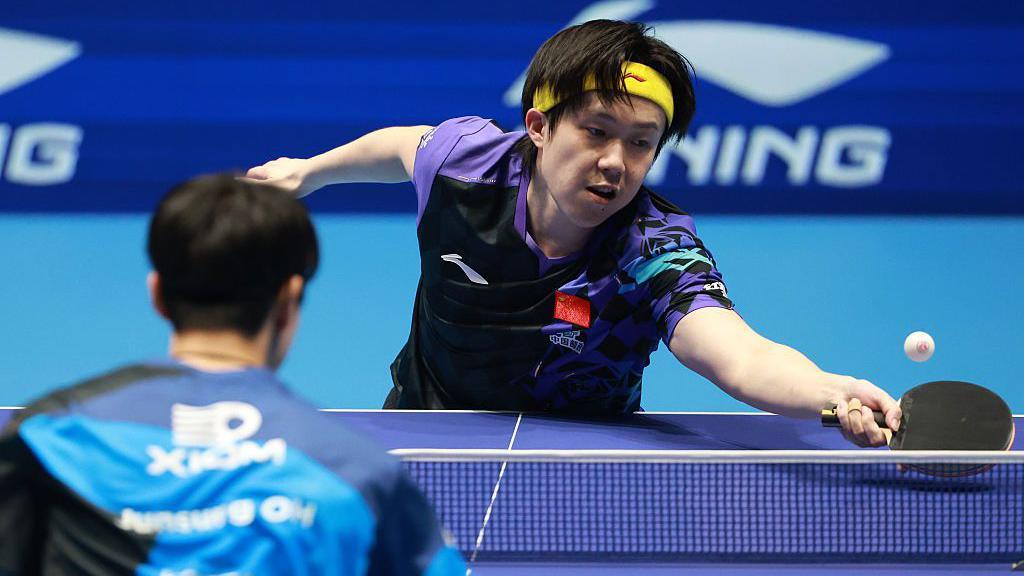
China Men’s Table Tennis Dynasty: World Championship Title Defense Sealed With Authority
The narrative of global table tennis has one constant: the red flag flying highest. China’s men’s national team has once again demonstrated why they sit alone at the summit, successfully defending their world championship title in a performance that blended tactical mastery, psychological resilience, and raw athleticism.
This is not merely a victory—it is a statement. A declaration that the gap between the best and the rest remains as wide as ever.
The Anatomy of a Dominant Title Retention
A Final Built on Precision and Poise
From the very first point, the Chinese squad dictated the tempo. Opponents who had spent months studying game footage, simulating pressure situations, and refining their own strategies found themselves outmaneuvered at every turn.
The final scoreline, while decisive, cannot fully capture the chess-like complexity of the rallies. Each player delivered under the brightest lights, turning what could have been a tense contest into a clinical exhibition of world-class table tennis.
Key elements of the performance:
- Tactical adaptability: Mid-match adjustments were seamless. Coaches and players communicated with the efficiency of a well-oiled machine, switching between aggressive loops, defensive chops, and short-push games as the situation demanded.
- Mental fortitude: Pressure points—deuce games, match-point saves, comeback surges—were handled with an almost robotic calm. The team did not flinch when momentum briefly shifted.
- Depth of roster: Unlike nations that rely on one or two superstars, China rotated contributors who each played their role to perfection. The bench strength is not just a luxury; it is a weapon.
What Sets This Team Apart from Previous Generations
Evolution of Technique in the Modern Era
The current squad has absorbed lessons from legends like Ma Long, Zhang Jike, and Wang Hao, but they have also modernized the game.
The speed of the ball has increased. Spin rates are higher. Recovery time between points is shorter. China’s players have adapted by refining their footwork patterns, developing more explosive first-step acceleration, and integrating data analytics into their training cycles.
Technical innovations on display:
- Serve-and-third-ball combinations: Every server used disguised tosses and wrist flick variations that made return quality drop dramatically.
- Forehand dominance from both wings: The modern Chinese forehand loop is flatter, faster, and more punishing than ever before.
- Backhand resilience: Weaknesses that once existed on the backhand side have been neutralized. Counter-loops, blocks, and even backhand smashes are now routine weapons.
The Psychological Edge: Why China Thrives Under Pressure
Table tennis is a sport of millimeters and milliseconds. One lapse in concentration can cost a set. One lost set can shift momentum irrevocably.
Yet China’s players consistently perform at their peak in the highest-stakes moments. This is not accidental.
Psychological training methods used by the team:
- Simulated crowd noise during practice to replicate hostile environments
- High-intensity interval drills designed to induce fatigue before tactical decision-making
- Mindfulness and visualization exercises embedded into daily routines
- Peer accountability sessions where players critique each other’s mental lapses without ego
The result is a squad that treats a world championship final as just another match—albeit one with a massive trophy on the line.
Implications for the Global Table Tennis Landscape
Raising the Benchmark for Every Nation
China’s continued dominance is both a source of inspiration and a challenge for rival teams. Germany, Japan, South Korea, and Sweden have all invested heavily in grassroots development, advanced coaching, and sports science.
Yet the gap persists.
Reasons for the sustained gap:
- Infrastructure density: China has thousands of provincial training centers feeding into a national pipeline. No other country matches that scale.
- Cultural prioritization: Table tennis is embedded in schools, community centers, and family traditions, competing less with other major sports for attention.
- Continuous reinvention: Every Olympic cycle brings new tactical systems and technical refinements.
What Rivals Can Learn from This Victory
Rather than being disheartened, rival programs will study this match closely.
Key coaching takeaways:
- Adaptability must be trained, not assumed. Players need drills that force mid-rally tactical shifts.
- Transition play is underdeveloped globally. China excels at switching from defense to offense in a single stroke.
- Mental conditioning is decisive. Technique collapses under pressure without psychological stability.
Looking Ahead: The Road to Future Glory
Olympic and World Cup Prospects
With this title retained, attention shifts to the Asian Games, the World Cup, and ultimately the Olympic Games.
The current core remains in its prime, while younger talents continue pushing upward through an elite development pipeline. Depth remains one of China’s most decisive advantages.
Potential emerging threats:
- Japan’s next generation built around aggressive forehand systems
- Germany and Sweden’s physically stronger European prototypes
- South Korea’s evolving doubles-focused innovations
Still, the structural advantage China holds—coaching continuity, talent density, and internal competition—remains formidable.
The Legacy Factor
For the players in red, this victory is more than a result sheet. It is a continuation of a dynasty built over generations.
They carry forward a lineage shaped by pioneers like Rong Guotuan, and modern icons like Ma Long. Every point played is both personal performance and historical continuation.
Why This Matters Beyond the Scoreboard
Inspiring a New Generation of Athletes
Across China, this victory will ripple through schools, academies, and training halls.
Expected impact:
- Increased enrollment in table tennis programs
- Expanded media coverage of domestic competitions
- Strengthened funding for youth development systems
- Renewed national pride through sport
A Reminder of Sport’s Enduring Power
In an era of constant digital distraction, a world championship still captures collective attention.
The rhythm of rallies, the silence before serve, the eruption after a final point—these moments remain universally understood, regardless of language or geography.
Final Reflections
China’s men’s table tennis team did not just retain a title. They reaffirmed a system.
A system built on repetition, refinement, and relentless internal competition.
The world can observe, adapt, and attempt to close the gap—but for now, the standard remains firmly set at the top.