Mark Carney Stakes Canada’s Sovereignty and Values in Fiery Global Progress Summit Address
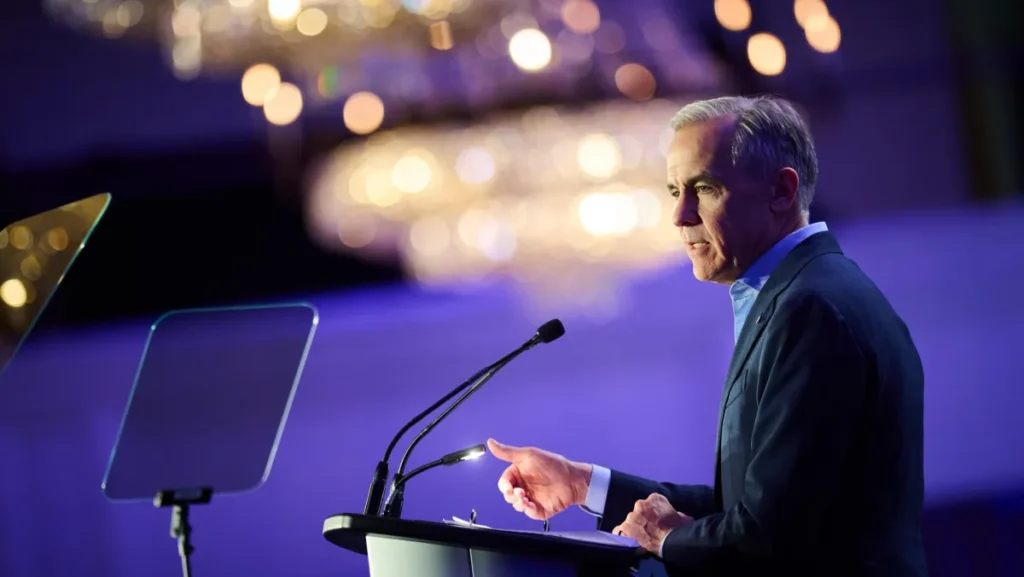
The political landscape of North America shifted decisively this week as Prime Minister Mark Carney took the stage at the Global Progress Summit. In a speech that quickly reverberated through diplomatic channels and financial markets, Carney delivered what analysts are calling the most definitive articulation of Canadian identity in a generation.
This was not a standard policy speech. It was a cultural and economic declaration. For a leader who spent his career in the arcane worlds of central banking and international finance, the address was strikingly personal, direct, and profoundly nationalistic in the best sense of the word.
From Banker to National Defender: Carney’s Core Message
The heart of Carney’s address rested on a simple but powerful premise: Canada will not be bullied into submission, nor will it trade its principles for short-term economic convenience.
The context, of course, is the ongoing trade warfare and the simmering annexation rhetoric that has dominated headlines since the previous administration in Washington. While Carney never named the United States directly, the subtext was impossible to miss. He spoke of a world where the old rules of global order are being shattered, not by accident, but by design.
Carney argued that the current crisis is not merely about tariffs or trade deficits. It is a fundamental clash of values. He positioned Canada not just as a victim of this new aggression, but as a living alternative.
He rejected the notion that the only path to prosperity is through zero-sum nationalism or the dominance of the largest economy. Instead, he proposed a model of resilience built on three pillars:
- Open, rules-based trade that does not sacrifice sovereignty
- Social investment that strengthens the middle class rather than extracting wealth for the few
- Environmental leadership as a competitive advantage, not a burden
This is where Carney’s background becomes essential. As the only person to have led both the Bank of Canada and the Bank of England, he understands leverage. He knows that power in the 21st century is not just military or industrial—it is financial and institutional.
His speech signaled that Canada intends to use every tool in that toolbox to defend its interests.
A Rejection of Economic Annexation
The most compelling portion of the speech addressed what Carney termed “the soft annexation of economic dependency.”
This was a direct rebuke to the idea that Canada’s destiny is somehow tied to becoming the 51st state or a junior partner in a continental project.
He argued that when a country allows its neighbor to dictate its monetary policy, energy exports, and digital regulations, it has effectively surrendered its independence.
Carney’s argument was not about isolationism. He explicitly called for deeper ties with Europe, the Indo-Pacific, and emerging economies. The goal is to diversify Canada’s economic relationships to the point where no single partner can hold the nation hostage.
This is a massive strategic pivot. For decades, Canada was comfortable being the supplier of raw materials and a safe, boring neighbor. Carney is tearing up that script.
He offered specific critiques of the “extract now, pay later” philosophy. He pointed out that Canada possesses the critical minerals, the energy security, and the stable banking system that the entire Western world is desperate for.
Instead of undervaluing these assets to please a single buyer, Carney proposed a national strategy of value-added processing and sovereign wealth generation.
He warned that the old model of exporting raw resources and importing finished goods is a strategy for decline, not prosperity.
The Rhetorical Shift: Carney vs. The New World Order
What made this speech different from typical Canadian political rhetoric was its intellectual aggression. Carney did not apologize for Canada’s strengths. He leaned into them.
He discussed the Canadian healthcare system not as a weakness, but as a competitive advantage that reduces business costs for employers and creates a more stable workforce.
He championed the country’s immigration policy as an engine of demographic growth that other aging nations can only envy.
He then drew a sharp contrast with the emerging global consensus that prioritizes short-term shareholder returns over long-term societal health.
Carney decried what he called the “commodification of national identity.”
This is where his expertise in climate finance came to the forefront. He argued that countries that ignore the environmental consequences of their growth are building their wealth on a foundation of sand.
He called for a carbon pricing system that is both effective and equitable, rejecting the false choice between economic growth and environmental protection.
The language was unmistakably progressive, yet it was framed within a hard-nosed realist lens. This was not the idealism of a career politician. This was the conviction of an economist who has seen the data.
He argued that the countries that invest in green technology, education, and healthcare will be the ones that dominate the next century.
He left no room for doubt that he intends to lead Canada into that camp.
The Policy Implications for Canada
For businesses and investors watching this speech, the implications are clear: the era of cheap, easy access to the American market is over, and Carney’s government is not going to cry about it.
The policy agenda that follows from this speech will likely include:
- Massive interprovincial trade liberalization to create a true internal market
- Accelerated approvals for critical mineral mining and refining
- Targeted industrial subsidies for green technology and advanced manufacturing
- A more aggressive posture in international trade disputes and regulatory negotiations
This is not a radical break from the past, but it is a dramatic acceleration.
Carney is betting that Canada can build a 21st-century economy that is both prosperous and principled.
He is betting that Canadians are tired of being treated as a footnote in someone else’s story.
Why This Speech Matters Beyond the Border
For American readers, this speech should be a wake-up call.
Carney was sending a signal to Washington that the old dynamic has changed. The assumption that Canada will always cave in a trade dispute, that it will always find a workaround, that it will never risk a confrontation—that assumption is dead.
Carney has the intellectual firepower and the political mandate to fight back. He is not looking for a trade war, but he is no longer running from one.
He also sent a signal to the rest of the world. He positioned Canada as a reliable, stable partner in a time of global uncertainty.
He offered Canada as a bridge between Europe and the Americas, between the developed and developing worlds.
He argued that a country can be progressive without being weak, and that a country can be patriotic without being xenophobic.
A New Vision for Canadian Leadership
The speech ended with a call to action that was both humble and audacious.
Carney reminded the audience that Canada is not a superpower. It cannot dictate terms to anyone.
But he argued that moral authority and economic credibility are powerful currencies in their own right.
He suggested that Canada can lead not by being the biggest, but by being the most consistent. By showing that a diverse, open, and resilient society can thrive in a turbulent world.
This is the core of Carney’s vision. He is offering a third way: neither the hyper-capitalism of the American model nor the stagnation of the European model.
He is proposing a Canadian model—one that balances innovation with security, competition with compassion, and ambition with humility.
Only time will tell if this vision can be realized.
But one thing is certain from this speech: Mark Carney intends to write Canada’s next chapter himself.
He is not content to be a manager of decline. He is positioning himself as the architect of a renaissance.
For anyone interested in the future of North America, this speech was a defining document. It was a declaration of independence, not from the United States, but from the fear that Canada might not have what it takes to stand alone.