
Canada Explores Keystone XL Pipeline Revival Under Potential Trump Administration
The long-dormant debate over the Keystone XL pipeline has roared back to life, emerging as a central topic in high-level discussions between Canadian officials and advisors to former U.S. President Donald Trump. With the 2024 U.S. presidential election on the horizon, the prospect of a second Trump term has reignited hopes in Canada’s energy sector for the revival of the controversial cross-border project. This development signals a strategic pivot, as Canada positions itself to capitalize on a potential shift in American energy and climate policy.
A Pipeline Reborn: The Political Landscape Shifts
The Keystone XL pipeline, envisioned to carry up to 830,000 barrels of crude oil daily from Alberta’s oil sands to refineries on the U.S. Gulf Coast, has been a political football for over a decade. Its journey has been marked by fierce environmental opposition, regulatory hurdles, and stark partisan divides.
President Joe Biden’s cancellation of the pipeline’s key permit on his first day in office in 2021 was a decisive blow, aligning with his administration’s climate agenda. However, with Donald Trump leading in many polls, the calculus has changed. Trump, who previously approved the pipeline during his first term, has openly voiced support for its revival, framing it as an issue of energy independence, job creation, and economic partnership with Canada.
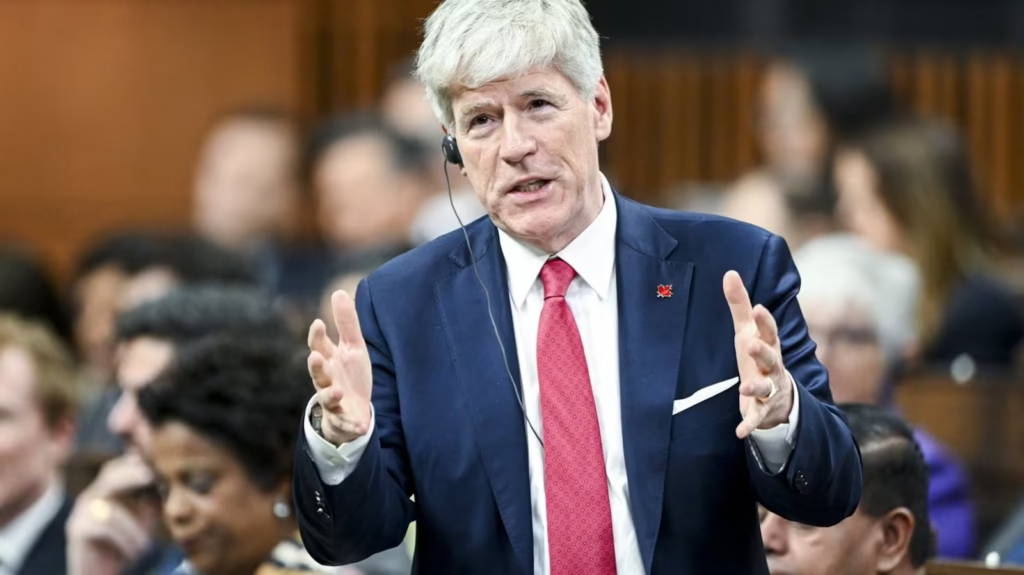
Canadian Natural Resources Minister Jonathan Wilkinson confirmed that the topic has been broached in conversations with Trump’s team. “It is important that we are prepared for all possible outcomes of the U.S. election,” Wilkinson stated, emphasizing the need for Canada to safeguard its economic interests. These discussions, while preliminary, underscore a proactive effort to ensure the project is “shovel-ready” should the political winds change in Washington.
The Stakes for Canada: Energy, Economy, and Environment
For Canada, the Keystone XL pipeline represents more than just an infrastructure project; it is a symbol of its complex energy ambitions and economic dependencies.
Economic Imperatives and Market Access
The Canadian oil industry, primarily centered in Alberta, has long struggled with constrained pipeline capacity and discounted prices for its crude. Keystone XL promised a direct conduit to the world’s largest refining market, offering:
- Enhanced export capacity and reduced reliance on a single U.S. buyer.
- Higher prices for Canadian heavy oil by accessing premium Gulf Coast markets.
- Thousands of construction jobs and sustained economic activity on both sides of the border.
Proponents argue that modern pipelines are the safest and most efficient method for transporting oil, and that blocking Keystone XL does little to reduce global demand, instead ceding market share to producers with lower environmental standards.
The Unyielding Environmental Opposition
Revival efforts will inevitably collide with the powerful and well-organized environmental movement. Opponents contend that enabling further expansion of the oil sands is incompatible with urgent climate goals. Key arguments include:
- The project locks in decades of high-carbon infrastructure.
- It poses risks to critical ecosystems and water sources along its route, including the Ogallala Aquifer.
- It undermines international commitments to reduce greenhouse gas emissions.
First Nations and Indigenous groups, whose territories the pipeline would cross, remain pivotal stakeholders, with many communities continuing to voice strong opposition based on environmental and sovereignty grounds.
Navigating a New Reality: Challenges to Revival
Even with a theoretically friendly White House, resurrecting Keystone XL is fraught with obstacles. The political and legal landscape has evolved since the project was first proposed.
Legal and Regulatory Hurdles: The pipeline would need to navigate a fresh permitting process, which would likely face immediate and sustained legal challenges from environmental groups and states like Nebraska, where route disputes have historically caused significant delays.
Changed Economic Fundamentals: The global energy transition has accelerated since 2021. Many major financial institutions have adopted policies against financing fossil fuel expansion, potentially making it more difficult to secure the billions in capital required. Furthermore, the company originally behind the project, TC Energy, has written off its investment and dissolved the partnership developing it, leaving no clear corporate champion.
Shifting Public and Corporate Sentiment: While support remains in certain regions, the broader corporate and societal focus has shifted toward ESG (Environmental, Social, and Governance) principles and decarbonization. A revival attempt could spark significant backlash and protests, reminiscent of the Standing Rock demonstrations against the Dakota Access Pipeline.
Conclusion: A Strategic Gamble on the Future of North American Energy
Canada’s exploration of a Keystone XL revival under a potential Trump administration is a high-stakes gamble. It reflects a pragmatic, if contentious, strategy to secure the future of its vital energy sector amid global uncertainty. For the Canadian government, it is a delicate balancing act: advocating for the economic interests of its resource-producing provinces while maintaining its own domestic commitments to climate action and reconciliation with Indigenous peoples.
The ultimate fate of Keystone XL now appears inextricably linked to the outcome of the U.S. presidential election. A Trump victory could open the door to a dramatic second act for the pipeline, setting the stage for a monumental political and legal battle. A Biden re-election would almost certainly keep the project consigned to history. What is clear is that this iconic pipeline remains a powerful litmus test for North America’s competing visions on energy, the economy, and the environment. The discussions happening today are not just about steel and crude oil; they are a preview of the continent’s energy direction for decades to come.

