
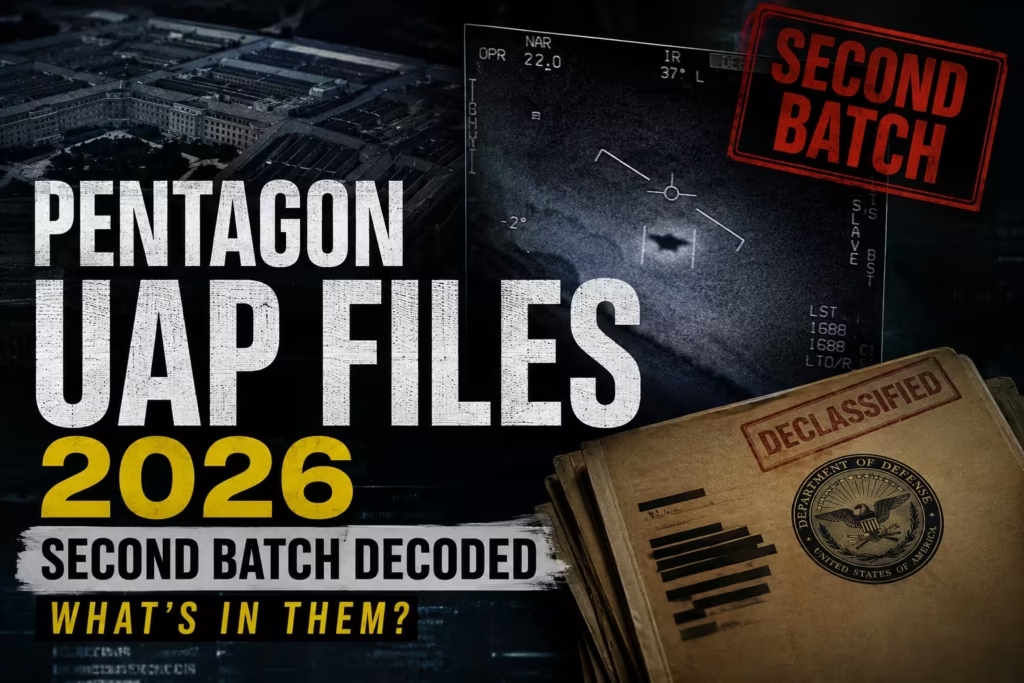
Pentagon Drops Second UAP File Batch: Orbs That Chased Fighter Jets, Color Video, and a Billion Hits on a Government Website
The Department of Defense released 64 new UAP records on May 22, 2026 — including a senior intelligence officer’s account of orange orbs that scrambled military jets and left the crew “virtually speechless.” A third wave is already confirmed. Here’s a full, expert breakdown of what the files actually contain and what they mean.
Second Batch — At a Glance
Two weeks after the most significant government UFO disclosure in modern American history, the Pentagon returned to the podium. On Friday, May 22, 2026, the Department of Defense published a second tranche of declassified Unidentified Anomalous Phenomena records — 64 files in total, including 51 video clips, 6 PDF documents, and 7 audio recordings — all now publicly accessible through the government’s dedicated portal at war.gov/ufo. Together with the initial May 8 release, the United States government has now placed more than 200 UAP records into the public domain, a development that would have been functionally unimaginable a decade ago.
The release is being executed under the PURSUE program — the Presidential Unsealing and Reporting System for UAP Encounters — an executive directive issued by President Donald Trump earlier this year. The administration has framed the disclosures as a transparency initiative. The numbers back up the public appetite: since launching on May 8, the war.gov/ufo portal has registered more than one billion hits, a figure the Pentagon itself confirmed. That is not the traffic of a nation merely curious. That is a nation that suspects it has been kept in the dark for a very long time.
In the distance, we saw countless orange orbs swarming in all directions against the backdrop of the mountain. The display lasted several minutes before fading.
— Senior U.S. Intelligence Officer, late 2025, from the second UAP batchThe Most Striking Document: An Intelligence Officer’s Testimony
Of everything released on May 22, the document drawing the most sustained attention from analysts and the public alike is a written account by a currently serving senior U.S. intelligence officer. The incident took place in late 2025 during a military helicopter mission. What follows is, by any institutional standard, a remarkable piece of testimony from someone operating within the national security apparatus.
The officer describes what his crew experienced as a series of close UAP encounters lasting over an hour. First, in the distance: countless orange orbs swarming in all directions against the backdrop of a mountain, a display that lasted several minutes before fading. Then, at closer range: two large orbs flared up side by side near the helicopter, stationary and just above the rotor disk. The officer described the objects as oval-shaped, orange with a white or yellow center, emitting light in all directions. Fighter jets were scrambled to intercept and identify the phenomena. They could not. What happened next is the detail that has stopped observers cold: the same orbs the crew had encountered then began — in the officer’s own words — chasing the fighters. The account closes with a sentence that, coming from a trained intelligence professional with no apparent incentive to embellish, carries considerable weight: “We were virtually speechless after these observations.”
The Pentagon has not attempted to explain the encounter. The All-domain Anomaly Resolution Office (AARO), the body responsible for reviewing UAP cases, noted that many files in both drops remain “unresolved” — meaning no definitive determination has been made about the nature of what was observed. That framing is deliberate. It is not a concession of extraterrestrial origin; it is also not a dismissal.
What’s Actually in the 51 Videos
The video component of the second batch marks a notable qualitative improvement over the first drop, which drew criticism for featuring largely blurry, low-resolution thermal imagery. This release includes footage shot in full color — the first time color video has appeared in the public archive — and several clips that offer a level of clarity unprecedented in the government’s declassified record.
Notable Files From the Second Batch
- VideoCoast Guard, April 2024 — Southeastern U.S.: Infrared footage showing an unidentified object flying near a civilian aircraft over the southeastern United States.
- Video“Syrian UAP Instant Acceleration,” 2021: Infrared sensor footage from a U.S. military platform, uploaded to a classified network in 2024. Object executes what the Pentagon describes as sudden, rapid acceleration.
- VideoSphere over population center, 2020 (CENTCOM): A sphere filmed flying over an undisclosed population center under U.S. Central Command’s area of responsibility, before ascending and disappearing into the sky.
- VideoUAP shot down over Lake Huron, Feb 12, 2023: Footage of a U.S. Air Force National Guard engagement with a UAP over Lake Huron — one of the clearest military engagement clips in the archive.
- VideoOrbs near submarine: Multiple orb-like UAPs observed moving in different directions and executing rapid direction changes in close proximity to a U.S. submarine. Some appear to float on the ocean surface.
- VideoSpherical UAP pulsing over water, June 2024: A shiny orb that pulsates and then vanishes. First instance of a color (non-thermal) video in the public government archive.
- DocumentSandia Base files, 1948–1950 (116 pages): Historical records documenting 209 sightings of green orbs, discs, and fireballs reported near a top-secret nuclear weapons facility in New Mexico, including investigations into copper powder found at some sites.
- DocumentSenior intelligence officer’s account, late 2025: First-person written account of close UAP encounters lasting over an hour, including orange orbs that chased scrambled fighter jets.
- AudioSeven audio files: Transcripts and recordings of personnel reporting unexplained orbs, discs, and fireballs. Full content of individual recordings has not yet been fully analyzed publicly.
From 1948 to 2025: The Breadth of the Archive
One of the most significant aspects of the cumulative release — spanning both drops — is the temporal range it covers. At one end sits a 116-page document from Sandia, New Mexico, cataloguing 209 sightings of green orbs, discs, and fireballs near what was then one of America’s most sensitive nuclear installations between 1948 and 1950. Investigators at the time documented not just the sightings themselves but physical anomalies at the sites, including the presence of unexplained copper powder. At the other end sits the 2025 intelligence officer account. That is 77 years of documented institutional awareness of unexplained aerial phenomena near some of the United States’ most sensitive military assets — with the pattern recurring across administrations, theaters of operation, and technological generations.
The first batch, released May 8, was equally sweeping in its own right. It included declassified pages from the FBI’s UFO case files spanning 1947 to 1968, military pilot encounter reports, diplomatic cables from U.S. posts around the world, NASA mission photography flagged for anomalous content, internal memos describing sightings in Iraq in 2022, Syria in 2024, and sightings by U.S. troops stationed in the United Arab Emirates and Greece.
The PURSUE Program: What It Is and What’s Coming
The governing framework for all of this is PURSUE — the Presidential Unsealing and Reporting System for UAP Encounters — Trump’s executive directive ordering the declassification and public release of government-held UAP material. Chief Pentagon spokesperson Sean Parnell confirmed on May 19 that the declassified records are being actively processed for publication and that more releases are coming soon. Representative Tim Burchett, one of Congress’s most vocal UAP disclosure advocates, has previewed what is coming in starker terms, writing on X that the first drop will seem like a drop in the bucket in comparison to what is coming.
If that assessment is accurate — and Burchett has a track record of being briefed ahead of public releases — then the current two-batch archive represents only the opening chapter of a disclosure process with no clear endpoint. The government’s own framing has been careful: AARO has found no confirmed evidence of extraterrestrial origins in the released material, and officials have been consistent in qualifying the releases as unresolved rather than unexplained-by-design. But the institutional posture has shifted fundamentally. The U.S. government is no longer in the business of dismissal. It is in the business of documentation.
What the Experts Are Actually Saying
The response among serious UAP researchers, former intelligence officials, and national security analysts has been measured but notable in its departure from earlier skepticism. What the files do not provide is confirmation of nonhuman intelligence or extraterrestrial technology. What they do provide — consistently, across decades and theaters — is a record of objects exhibiting flight characteristics and behaviors that no currently acknowledged human technology can replicate: instant acceleration, transmedium travel (moving between air and water without apparent disruption), formation behavior near nuclear assets, and objects that respond to military aircraft in ways that imply awareness of their presence.
The intelligence officer’s account of orbs chasing fighter jets is the sharpest illustration of that last point. A passive, drifting object does not chase a scrambled F-16. An object that responds to a pursuit vector with a counter-pursuit behavior is, by any analytical standard, exhibiting something that demands rigorous and honest explanation. The Pentagon has not provided one. That is, in its own way, as significant as anything in the videos themselves.
What Comes Next
A third wave of UAP file releases is confirmed. The processing timeline has not been specified beyond “very soon,” but the architecture is already in place: war.gov/ufo is a live, updating repository, not a static archive. Congressional pressure from both parties continues to mount, with lawmakers from the House and Senate Armed Services committees pushing for complete disclosure of all government-held UAP material — including any records related to alleged recovered materials programs, a category that has not yet appeared in either public drop.
The billion-hit figure on the Pentagon’s UAP portal is not a curiosity. It is a data point about public trust, institutional credibility, and the cost of decades of official ambiguity. The American public, and frankly the global public, is paying attention. The question that now hangs over every subsequent file drop is not whether the government knows more than it has released. The question is how much more — and what kind.
This article is based on publicly available declassified files released by the U.S. Department of Defense via war.gov/ufo, supplemented by reporting from CBS News, ABC News, Newsweek, The Washington Times, and Fox News as of May 24, 2026. No claims of extraterrestrial origin are made or implied. The All-domain Anomaly Resolution Office has made no such determination in any file released to date. This report will be updated as subsequent file drops occur.