
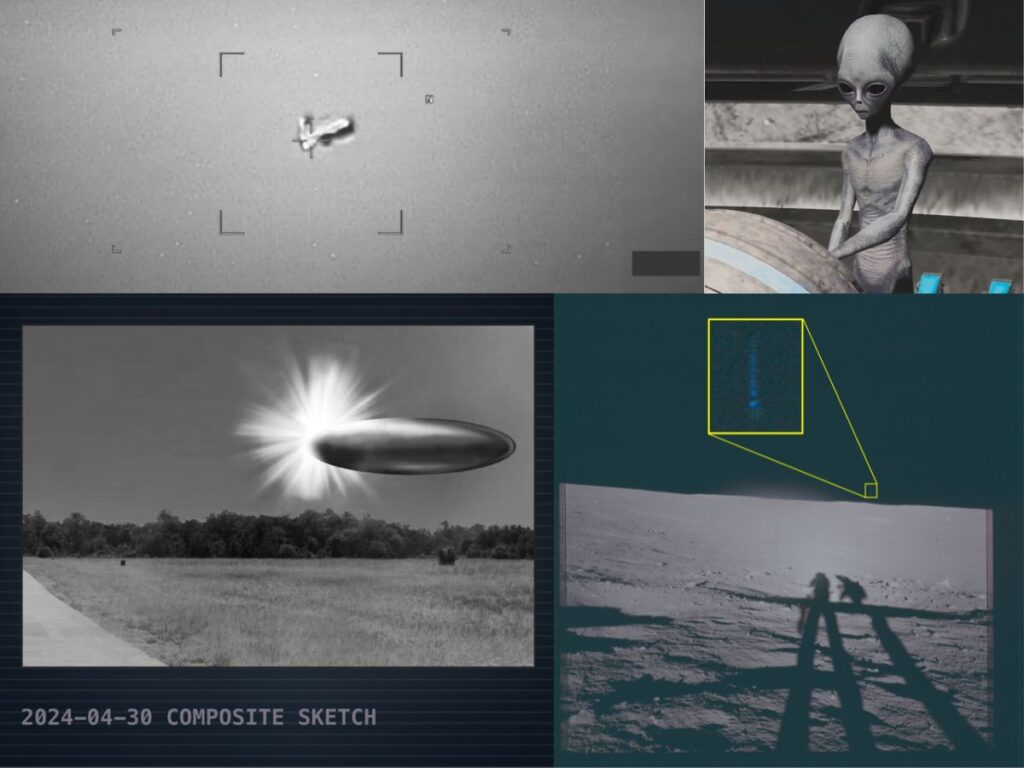
Pentagon Declassifies UFO Reports: Public Now Empowered to Analyze UAP Data
The Pentagon has released a new tranche of declassified Unidentified Aerial Phenomena (UAP) reports, marking a notable shift in how the U.S. government communicates about unexplained aerial encounters. For the first time, officials are explicitly encouraging the public—not just analysts within defense circles—to examine the material and draw independent conclusions.
This is not routine disclosure. It reflects a broader policy evolution toward transparency, driven by sustained congressional scrutiny and growing institutional recognition that UAP reports can no longer be managed solely behind classified channels.
From Secrecy to Structured Transparency
For decades, UFO reporting was treated as a peripheral concern within defense intelligence—often dismissed, downplayed, or siloed within highly restricted programs. That posture has changed significantly with the establishment of the All-domain Anomaly Resolution Office (AARO), which now serves as the central hub for collecting and analyzing UAP data across the U.S. government.
The latest release includes structured case files, pilot debriefs, and sensor-derived observations previously withheld from public access. While the documents do not offer definitive explanations, they provide a clearer picture of how seriously such incidents are now being tracked.
Key elements of the release include:
- Pilot and crew reports describing high-speed aerial objects with no identifiable propulsion systems
- Multi-sensor recordings combining radar, infrared, and electro-optical data
- Internal assessment frameworks used to classify and evaluate UAP encounters
- Case summaries that remain unresolved despite formal analysis
Rather than presenting conclusions, the Pentagon is releasing raw observations and inviting external review—an approach more consistent with scientific data-sharing than traditional defense communication.
Why Public Analysis Is Being Encouraged
From an analytical standpoint, the shift toward public engagement is strategic rather than symbolic. Defense officials are effectively expanding the review ecosystem beyond classified environments, leveraging external expertise to accelerate pattern recognition and hypothesis testing.
1. Broader Analytical Capacity
Outside government structures, there exists a large global community of aerospace engineers, data scientists, radar specialists, and aviation enthusiasts capable of independently reviewing flight anomalies. By releasing structured data, the Pentagon is effectively enabling distributed analysis at scale.
This increases the likelihood that subtle correlations—such as atmospheric conditions, sensor artifacts, or flight-path overlaps—can be identified more quickly than within closed institutional workflows.
2. Reducing Speculation Through Data Exposure
Historically, limited transparency has fueled speculation around UAP incidents. By releasing primary-source material, officials aim to shift discussion away from conjecture and toward verifiable evidence.
While this does not eliminate uncertainty, it narrows the interpretive gap between official assessments and external analysis.
3. Normalizing Reporting Within Aviation Culture
A recurring issue in past decades has been underreporting by military and civilian pilots due to stigma. The current framework explicitly supports standardized, non-punitive reporting channels for unexplained aerial events, treating them as legitimate safety and intelligence concerns.
This cultural shift is expected to increase reporting volume and improve dataset reliability over time.
What the Released Data Shows
The declassified files do not confirm any single explanation for UAP activity. Instead, they document recurring categories of observation that remain difficult to classify within known aerospace or atmospheric models.
Commonly cited characteristics include:
- Unusual flight dynamics: Reports of rapid acceleration and abrupt directional changes without visible propulsion or thermal signatures
- Cross-environment movement: Some cases describe objects transitioning between air and water without loss of velocity or control
- Multi-platform confirmation: Incidents tracked simultaneously by radar, infrared sensors, and visual observation
- Extended engagement windows: Encounters lasting long enough for multiple observation points and attempted communications
One frequently referenced case involves Navy aviators encountering an object exhibiting consistent positional matching behavior during flight maneuvers—an interaction that defies conventional drone or aircraft performance profiles.
Importantly, these accounts are observational in nature. They document what was detected, not what the objects are.
How Analysts Are Expected to Work With the Files
The Pentagon has structured the release in a way that allows external analysts to conduct parallel reviews. Researchers are encouraged to use cross-referencing methods to evaluate each case.
Common analytical approaches include:
- Matching timestamps with commercial and military flight tracking data
- Comparing radar anomalies with known atmospheric or electromagnetic interference patterns
- Reviewing satellite trajectories for potential observational overlap
- Filtering cases based on sensor redundancy and data consistency
This methodology reflects a shift toward open-source intelligence practices, where verification emerges through distributed validation rather than centralized interpretation.
Implications for UAP Research
While the release does not provide definitive answers, it does signal a sustained institutional commitment to documenting and analyzing UAP activity in a more transparent manner.
From a policy perspective, three developments stand out:
- Standardization of reporting frameworks across military branches
- Increased data availability for non-governmental analysis
- Gradual normalization of UAP study within defense and aviation contexts
What it does not do is confirm any extraordinary origin for these phenomena. The data remains inconclusive, and officials continue to emphasize that most cases ultimately lack sufficient evidence for definitive classification.
A Controlled Opening of the Data Landscape
The Pentagon’s decision to release these files represents a controlled but meaningful expansion of public access to UAP information. It does not rewrite existing explanations, nor does it endorse speculative conclusions.
Instead, it establishes a new working model: unexplained aerial events are now treated as legitimate data points subject to continuous review, not isolated anomalies to be dismissed or withheld.
The message from defense officials is measured but clear—these reports are no longer confined to internal analysis. They are now part of an open evidentiary record, and interpretation is no longer the sole responsibility of government institutions.
What the data ultimately represents remains unresolved. But the process of examining it has fundamentally changed.

