
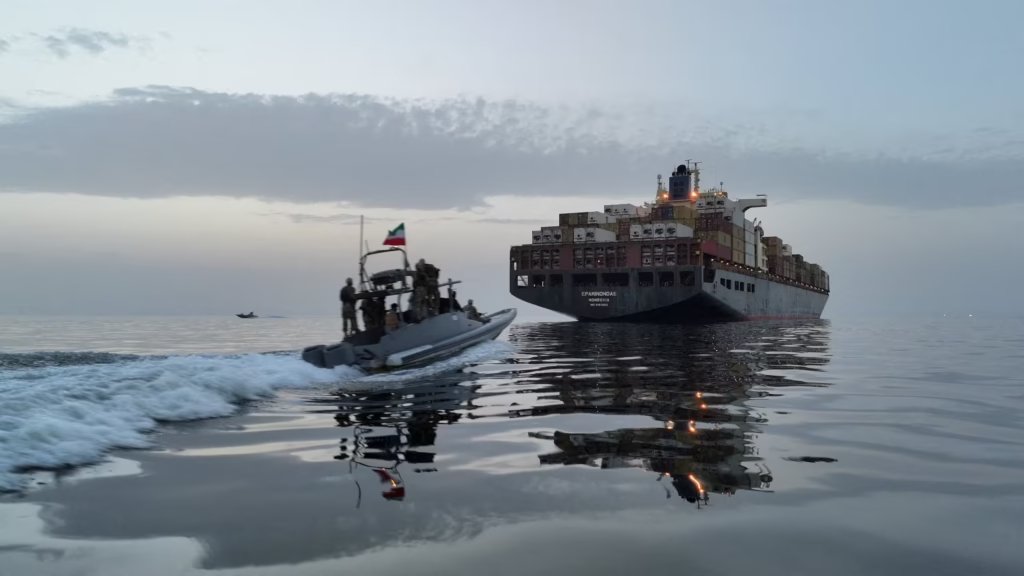
Strait of Hormuz Under Siege: Vessel Seized and Second Ship Attacked Amid Global Security Fears
The world’s most critical energy artery is rattled once again. Reports from naval authorities confirm that a commercial vessel has been forcibly seized in the Strait of Hormuz, while a second ship sustained damage from an attack in a separate, yet suspiciously timed, incident.
For anyone tracking global trade, energy security, or geopolitical risk, this is not background noise. This is a direct pressure test on the international maritime order.
The Strait of Hormuz is a narrow 21-mile-wide passage that carries roughly 20% of the world’s petroleum and nearly 25% of its liquefied natural gas. When this waterway faces disruption, the global economy reflexively tenses. Oil markets, shipping insurance, and military posture all shift in real-time.
This post will break down what we know, why it matters to your supply chain and portfolio, and what signals to watch in the coming days.
What Actually Happened? The Two Incidents Explained
According to reports from regional naval forces and security analysts, the sequence unfolded rapidly.
The Seizure
The first confirmed event was the seizure of a merchant vessel. While the flag state and cargo manifest are still undergoing verification, the tactical execution mirrors previous patterns:
- Approach by fast attack craft – a hallmark of state-aligned maritime forces in the region
- Communications blackout – the vessel stopped transmitting its Automatic Identification System (AIS) signal
- Boarding and diversion – the ship was rerouted toward Iranian territorial waters
This method is not new. In 2019 and again in 2021, similar seizures occurred as diplomatic leverage during nuclear negotiation windows.
The Attack
The second incident involved a direct assault on a separate vessel. Details remain sparse, but early intelligence suggests:
- Explosive contact – either a limpet mine or drone-borne munition
- Damage above the waterline – indicating a warning shot rather than a sinking attempt
- No casualties reported – suggesting the goal was disruption, not destruction
The proximity of these two events—one seizure, one strike—is the clearest signal that we are dealing with coordinated action, not random piracy.
Why These Attacks Matter Beyond the Region
If you think this is “just another Middle East flare-up,” look closer. The Strait of Hormuz is a systemically important node. Even a temporary reduction in traffic through this chokepoint triggers cascading effects.
Energy Supply Chain Risk
The immediate downstream impact is on crude oil and LNG flows. Tankers transiting the strait carry roughly 17 million barrels per day. A 10% reduction in traffic forces refiners to scramble for alternative supplies from the Atlantic Basin, which increases vessel demand and pushes freight rates higher.
Key consequences include:
- Spot price volatility – Brent crude will likely spike $3–$5 per barrel on the headline alone
- Asian premium widening – Japan, South Korea, and India are the largest importers via this route; they pay the highest marginal cost
- Inventories tested – Strategic petroleum reserves may be tapped if the disruption extends beyond two weeks
Maritime Insurance Shockwaves
For shipping operators, the word “Hormuz” triggers immediate re-rating. War risk premiums for vessels transiting the region can jump from 0.05% of hull value to 0.5% overnight.
To put that in numbers:
- A tanker worth $50 million pays $25,000 for standard transit coverage
- After an attack, that same crossing can cost $250,000 or more
- Those costs get passed directly to commodity buyers
This is not hypothetical. We saw the same pattern in 2019 after the Abqaiq–Khurais attacks and again during the 2020 tanker harassment campaigns.
Military Posture and Escalation Risk
Naval coalitions—including the Combined Maritime Forces and Operation Sentinel—maintain a persistent presence here. Any seizure or attack tests the credibility of their deterrent umbrella.
The key question for analysts: Was this conducted by state actors directly, or through a proxy? The answer determines whether we see a kinetic response or a diplomatic backchannel.
The Bigger Picture: Leverage, Not Chaos
Seasoned observers recognize the tactical footprint. These incidents are rarely random. They serve a strategic purpose.
Historical precedent tells us:
- In 2018–2019, a series of tanker attacks coincided with maximum sanctions pressure on Iran
- In 2021, a vessel seizure occurred during stalled nuclear talks in Vienna
- Today, we are in a period of high diplomatic ambiguity—nuclear negotiations are off-ramp, regional rivalries are high, and the U.S. administration is signaling both deterrence and restraint
This is not terrorism. This is bargaining through violence.
Is This a New Normal?
That depends entirely on the diplomatic response.
If the affected vessels turn out to be flagged in states that have leverage with Tehran, expect quiet negotiations and a prompt release. If the vessels are Western-owned or flagged, expect a period of heightened naval patrols and tit-for-tat escalations.
The most dangerous scenario is a misidentification—where a strike hits a vessel flagged to a nation with its own naval capability and a short fuse.
What to Watch in the Next 72 Hours
For readers managing exposure to oil, shipping, or geopolitical risk, here is your checklist:
- Flag state identity – Is the seized vessel flagged to a country that can resolve this diplomatically?
- Naval coalition statements – Look for the Combined Maritime Forces or UKMTO to release a formal incident report
- AIS tracking – Monitor TankerTrackers or MarineTraffic for unusual route deviations near the strait
- Oil futures open – Sunday evening trading in Brent and WTI will be the first real market reaction
- U.S. 5th Fleet posture – Any announcement of escort convoys or increased presence is a tell
Final Assessment
This is a flashpoint, not an earthquake—yet. The Strait of Hormuz has seen worse. The 1980s Tanker War involved hundreds of attacks. What looks dangerous today is actually a calibrated escalation designed to generate headlines and negotiation leverage.
But the margin for error is shrinking. One miscalculation—a sinking, a loss of life, or a retaliatory strike—could turn this from a news cycle story into a full-blown energy crisis.
Stay informed. Watch the flag states. And do not assume this gets resolved quietly.
What signals are you tracking? Drop your analysis in the comments.

