Premier Susan Holt’s Key Meeting with Mark Carney on New Brunswick’s Future
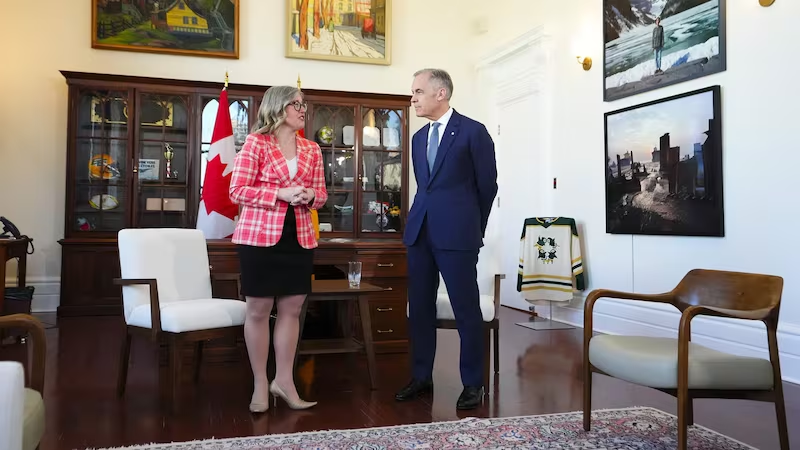
In a move signaling a proactive and forward-looking approach to governance, New Brunswick Premier Susan Holt recently held a pivotal meeting with former Bank of England and Bank of Canada Governor Mark Carney. This high-level discussion, centered on the province’s economic trajectory, underscores a strategic push to position New Brunswick competitively in a rapidly evolving global landscape. The meeting, which took place in Ottawa, was not merely a courtesy call but a focused dialogue on harnessing opportunity, attracting investment, and building a resilient, future-proof economy for all New Brunswickers.
Charting a Course for Economic Growth and Investment
At the heart of the discussion between Premier Holt and Mr. Carney was the critical need to attract substantial private capital to New Brunswick. The province stands at a crossroads, brimming with potential in sectors like clean energy, technology, and natural resources, but requiring strategic investment to unlock it fully.
The conversation focused on several key avenues for growth:
- Leveraging Clean Energy Leadership: New Brunswick’s assets in nuclear energy, small modular reactors (SMRs), wind, and hydrogen were highlighted as major draws for investors focused on the global energy transition and decarbonization goals.
- Building Investor Confidence: A significant portion of the dialogue revolved around “de-risking” projects to make them more attractive to large-scale institutional investors. This involves creating clear, stable policy frameworks and demonstrating the province’s commitment to being a reliable partner.
- Strategic Positioning: The pair discussed how to effectively “tell New Brunswick’s story” on the national and international stage, moving beyond traditional perceptions to showcase its innovative workforce, strategic location, and emerging economic strengths.
Mark Carney: A Trusted Voice in Global Finance
Mark Carney’s involvement is particularly noteworthy. As the UN Special Envoy for Climate Action and Finance, and with his unparalleled experience at the helms of two of the world’s most influential central banks, Carney brings a unique and powerful perspective. His current role at Brookfield Asset Management, focusing on the global transition to a net-zero economy, aligns perfectly with the opportunities New Brunswick is seeking to seize.
His advice is not theoretical; it is grounded in the practical realities of moving billions of dollars in investment towards sustainable projects. For Premier Holt, his insights provide a roadmap for connecting provincial ambitions with the vast pools of private capital looking for credible, impactful opportunities.
Beyond Economics: A Holistic Vision for New Brunswick
While the economic agenda was paramount, Premier Holt’s engagement with Carney reportedly touched on broader, interconnected challenges. A thriving economy is seen as the foundation for addressing other pressing provincial issues.
This holistic vision includes:
- Healthcare and Demographic Shifts: A stronger economic base is essential for sustaining and innovating the healthcare system, especially in the face of an aging population. New revenues can fund improvements in care, recruitment, and infrastructure.
- Housing Development: Attracting investment and growing the workforce is intrinsically linked to the need for more housing. The discussion acknowledged that economic growth must be paired with strategic plans to increase housing supply across the spectrum.
- Workforce of the Future: Preparing New Brunswickers for the jobs of tomorrow—in tech, skilled trades, and the green economy—is a prerequisite for success. The meeting reinforced the link between education, training, and economic strategy.
A Collaborative and Open Approach to Governance
This meeting is a clear embodiment of Premier Holt’s stated governing philosophy: openness, collaboration, and seeking the best ideas from wherever they may come. By engaging with an external expert of Carney’s caliber, Holt demonstrates a willingness to look beyond partisan or provincial boundaries for solutions. It signals to businesses, both within Canada and internationally, that New Brunswick is open for business and serious about creating a compelling investment climate.
This approach marks a distinct shift towards proactive, outward-facing leadership. Instead of simply managing existing challenges, the Premier’s office appears focused on strategically positioning the province to capitalize on major global trends, particularly the shift to a low-carbon economy.
What This Means for the People of New Brunswick
For residents, the substance of this high-profile meeting translates into tangible hopes for the future. The ultimate goal is to create a more prosperous, secure, and opportunity-rich province. A successful strategy born from such counsel could lead to:
- More and Better-Paying Jobs: Significant investment in key sectors directly leads to job creation, not only in construction and project development but in lasting operational and technology roles.
- Strengthened Public Services: A growing economy broadens the tax base, providing government with more resources to invest in healthcare, education, and infrastructure without disproportionate tax increases on citizens.
- Retention of Youth: By creating a dynamic economy with clear career pathways, New Brunswick can stem the tide of outmigration and become a place where young people choose to build their lives.
- National and International Relevance: Positioning the province as a leader in fields like SMR technology or green hydrogen elevates its profile, fostering pride and attracting further talent and investment.
The Path Forward from a Strategic Dialogue
The meeting between Premier Susan Holt and Mark Carney did not conclude with a signed deal or a sudden influx of capital. Its value is more foundational. It represents a critical step in refining New Brunswick’s economic narrative and strategy. The insights gained will undoubtedly inform policy development, investment attraction tactics, and the government’s priorities in the months and years ahead.
The true test will be in the execution. Translating high-level strategy into on-the-ground projects, streamlined regulations, and tangible results is the hard work that follows. However, by starting this conversation at the highest level, Premier Holt has set a new tone for ambition in New Brunswick. She has signaled that the province is not waiting for the future to happen but is actively working to shape it, drawing on world-class expertise to build a more resilient and prosperous home for all its citizens. This meeting is less about a single solution and more about charting a bold, confident, and informed course for New Brunswick’s future.