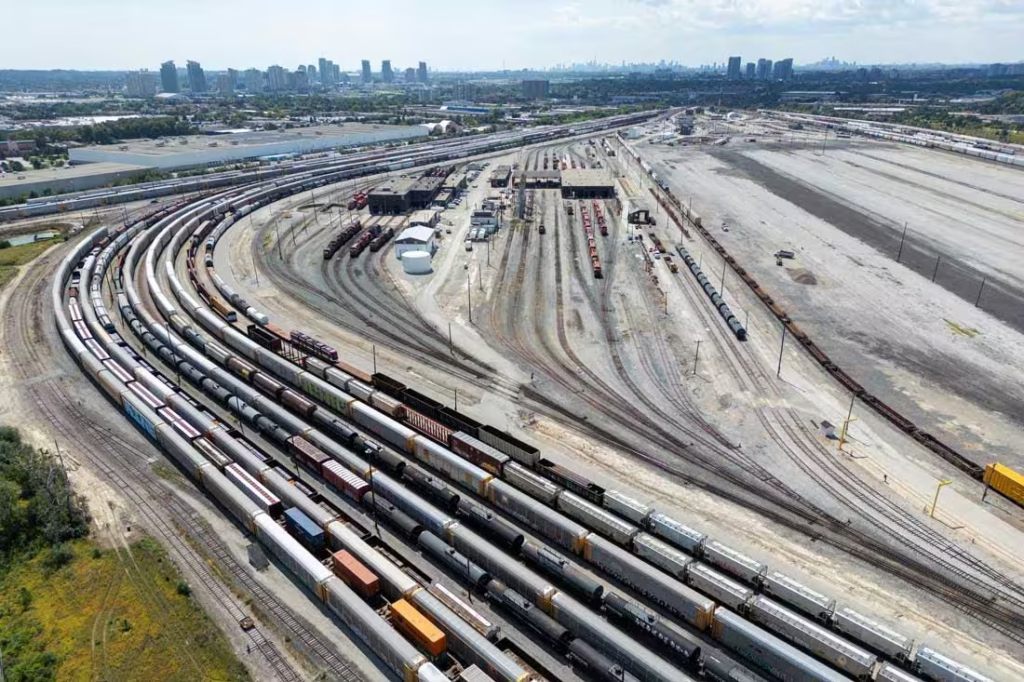
Canada’s Real-Time Rail Revolution: Anchoring Global Supply Chains in an Era of Uncertainty
When the world feels unpredictable, reliable infrastructure becomes a national asset. That’s exactly the message coming out of Ottawa as the Canadian government doubles down on its real-time rail initiative. In a recent address, the finance minister framed the country’s commitment to modernized rail data as a “point of stability” for both domestic shippers and international trade partners. For an industry that moves over $300 billion worth of goods each year, this isn’t just a tech upgrade—it’s a strategic pivot. Let’s unpack what real-time rail means, why it matters right now, and how Canada is positioning itself as a dependable link in increasingly choppy global waters.
What Exactly Is “Real-Time Rail”?
At its core, real-time rail is about transforming the way railways collect, share, and act on operational data. Historically, Canada’s rail network has relied on periodic updates—think end-of-shift reports or manual switch logs. Real-time rail flips that script by leveraging IoT sensors, GPS tracking, and cloud-based analytics to provide a live picture of every train’s location, speed, cargo condition, and track health.
The key components include:
- Locomotive telematics that broadcast position and performance data every few seconds.
- Wayside detectors that monitor wheel integrity, bearing temperature, and rail defects as trains pass.
- Centralized data platforms that fuse carrier information with shipper systems for end-to-end visibility.
This isn’t science fiction. Major carriers like CN and CPKC already run portions of their networks on near-real-time data. The government’s push is about making that interoperable—ensuring that a grain shipment from Saskatchewan can be tracked seamlessly across short-line railroads, mainline routes, and into U.S. connections.
Why It’s a Game Changer for Safety
Real-time data doesn’t just help logistics planners; it saves lives. With continuous monitoring, railways can detect a hot bearing or a track washout seconds after it happens—not after the next scheduled inspection. The Transport Canada Rail Safety Improvement Program has already funded pilot projects using real-time sensors to predict derailment risks. In a country where trains carry hazardous materials through populated areas, that capability is non-negotiable.
Stability in an Uncertain World: The Economic Argument
The finance minister’s framing wasn’t accidental. Global supply chains are still reeling from pandemic disruptions, geopolitical conflicts, and climate extremes. Ports clog, container shortages appear, and ocean freight rates spike. In that context, a predictable, high-capacity rail network becomes a competitive advantage.
Consider this: Canada moves roughly 75% of its exports to the United States over rail. When the global trading environment is volatile, partners look for corridors that won’t suddenly break. Real-time data allows shippers to reroute in minutes, not days. It gives customs brokers advance notice of cargo arrival. It even helps train operators optimize fuel consumption—cutting costs while reducing emissions.
The minister specifically highlighted that “in a world of shocks, Canada’s real-time rail capacity will be a source of confidence for investors.” That’s a direct pitch to multinational companies considering nearshoring or friend-shoring their North American operations. If you can see your freight moving second by second, you trust the system. And trust drives capital.
Supply Chain Resilience Starts with Visibility
The pandemic taught us a brutal lesson: you can’t manage what you can’t see. When border restrictions and labor shortages hit, rail operators relying on phone calls and spreadsheets were caught flat-footed. Real-time rail changes that equation. By integrating carrier data with shipper enterprise resource planning (ERP) systems, companies can:
- Identify bottlenecks before they become gridlocks.
- Match empty car supply with upcoming demand.
- Provide customers with accurate, up-to-the-minute delivery windows.
For sectors like automotive, agriculture, and energy—where just-in-time inventory is standard—that level of predictability is worth billions.
The Government’s Role: Investment and Regulation
Canada’s commitment isn’t just rhetoric. The 2024 federal budget allocated significant funds toward rail digitalization, building on the earlier Rail Safety Act amendments that mandated tighter data reporting. The finance minister emphasized that the government is working with industry to set common data standards—a critical step to ensure that real-time information flows seamlessly across competing carriers and international borders.
This public-private partnership approach matters. Without a shared “language” for data, each railroad might deploy its own proprietary system, defeating the purpose of network-wide visibility. Ottawa is pushing for an open architecture that small short-line railways can adopt without breaking the bank.
What It Means for Small and Mid-Size Shippers
One often-overlooked benefit: real-time rail democratizes information. Large grain companies or mining conglomerates have long had dedicated teams to track rail performance. Smaller shippers—like a family-owned lumber mill or a prairie pulse grower—often had to rely on phone calls. With a national real-time platform, those smaller players suddenly have the same visibility as the big guys. That levels the playing field and strengthens rural economies.
Challenges Ahead: Data Privacy and Cybersecurity
No serious discussion of real-time infrastructure is complete without addressing risk. More data means more attack surfaces. The finance minister acknowledged that the government is investing in cybersecurity frameworks specifically for rail digitalization. This includes encrypted data streams, mandatory breach reporting, and collaboration with the Canadian Centre for Cyber Security.
There’s also the question of data ownership. Shippers want to know that their cargo information won’t be used by competitors or sold to third parties. Clear policies on data governance are still being hammered out, and industry stakeholders are watching closely.
Looking Ahead: Real-Time Rail as a National Advantage
Canada is not alone in pursuing digital rail. The European Union has its own Digital Automatic Coupling initiative. The U.S. is advancing Positive Train Control mandates. But Canada’s unique geography—spanning six time zones, crossing multiple climate zones, and handling massive bulk commodity flows—makes real-time rail a particularly powerful tool.
The finance minister’s message resonates beyond transportation policy: in a fractured world, infrastructure that works reliably and transparently becomes a form of soft power. When a Japanese automaker or a German chemical company looks for a North American supply route that won’t be disrupted by political turmoil or climate shocks, Canadian real-time rail offers a compelling answer.
The Bottom Line
Real-time rail is more than a technological upgrade. It’s a bet that data-driven logistics can make Canada indispensable to global trade. The government is putting capital, regulatory focus, and diplomatic weight behind that bet. For shippers, carriers, and investors, the message is clear: Canada is building a railway for the future—and that future runs on real-time information.
As the finance minister put it, “In an uncertain world, stability is the new premium.” Canada intends to collect that premium, one real-time data point at a time.