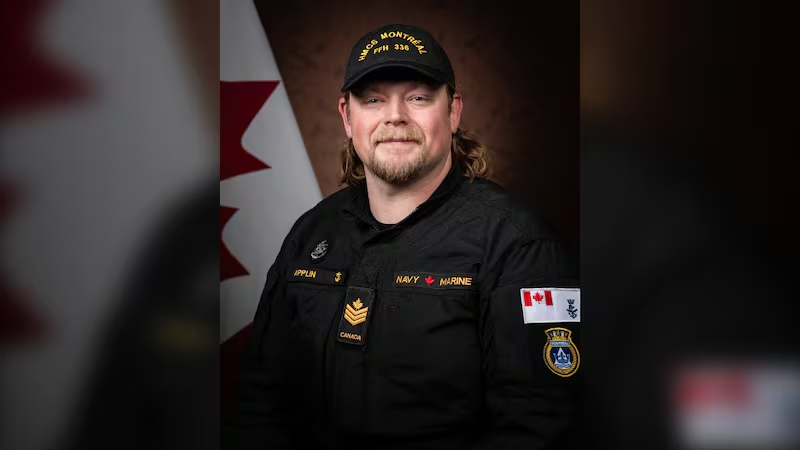
Royal Canadian Navy Sailor’s Death Leads to Serious Criminal Charges for Two Members
The close-knit community of the Royal Canadian Navy (RCN) in Halifax is navigating a storm of grief and sobering legal proceedings. The recent death of a sailor in the Bedford Basin has resulted in two fellow naval members facing serious criminal charges, marking a tragic and unprecedented event that has shaken the service to its core.
A Tragedy in Halifax Waters
In early May, the Bedford Basin—a familiar training ground and anchorage for the Atlantic Fleet—became the scene of a devastating incident. Petty Officer 2nd Class Morgan Johnathan Healey, a dedicated marine technician serving aboard HMCS Montreal, lost his life. The circumstances surrounding his death immediately triggered an investigation by the Canadian Armed Forces National Investigation Service (CFNIS), the independent military unit tasked with probing serious and sensitive matters.
The CFNIS investigation has now led to a rare and severe outcome. Two serving RCN members have been charged in connection with PO2 Healey’s death. Under a court-ordered publication ban, their identities are protected, a standard legal measure to ensure a fair trial. However, the gravity of the charges has been made public, casting a somber shadow over the fleet.
The Specific Charges and Their Gravity
The charges laid are not minor disciplinary infractions; they are serious criminal allegations under the Code of Service Discipline. The two members stand accused of:
- Negligent Performance of Duty: This charge implies a failure to fulfill a military duty with the care and attention that was reasonably required in the circumstances, resulting in a dire consequence.
- Criminal Negligence Causing Death: This is one of the most severe charges within the military justice system. It alleges that the accused showed a “wanton or reckless disregard” for the lives or safety of others, and that this conduct led to the death of another person.
The laying of these charges indicates that investigators believe there is evidence to support a claim of significant failure in duty of care, elevating the incident beyond a simple accident.
Immediate Fallout and Military Response
In response to the charges, the Royal Canadian Navy has taken swift administrative action. The accused members have been removed from all training and operational duties. This is a standard procedure intended to protect the integrity of the ongoing legal process, the members themselves, and their units.
The military has publicly emphasized its commitment to a thorough and transparent investigative and legal process. A statement from the Canadian Armed Forces highlighted that all members are expected to uphold the highest professional standards, and when those standards are alleged to have been fatally breached, the justice system must run its course.
Honouring Petty Officer 2nd Class Morgan Healey
Amidst the stark legal headlines, the human loss remains paramount. Petty Officer Healey was not just a name in a report; he was a marine technician—a crucial trade responsible for the operation, maintenance, and repair of a ship’s complex mechanical and electrical systems. His colleagues aboard HMCS Montreal and throughout the Halifax naval community have described him as a valued shipmate, a dedicated professional, and a friend.
The mourning within the RCN is profound. Military service fosters bonds deeper than typical workplace relationships; sailors rely on each other for safety and success in challenging environments. The loss of PO2 Healey in such circumstances creates a complex tapestry of sorrow, anger, and confusion for those who served alongside him.
Unprecedented Charges and Military Justice
While the Canadian military justice system routinely handles a wide range of offences, charges of criminal negligence causing death in an operational or training context are exceptionally rare. This case places a spotlight on the often-unseen pressures and immense responsibilities borne by military personnel.
Every day, sailors undertake hazardous tasks involving heavy machinery, complex systems, and the unpredictable marine environment. This tragedy forces a difficult but necessary conversation about:
- Safety Culture: Are all protocols being followed to the letter? Is there constant reinforcement of a “safety-first” mindset at every level?
- Accountability: How does the chain of command balance mentorship with accountability? This case demonstrates that the CAF holds its members accountable to the highest legal standards.
- Support Systems: What is the psychological impact on the crew of HMCS Montreal and the wider community? Ensuring access to mental health resources is critical in the wake of such trauma.
The Long Road Ahead: Legal Proceedings and Beyond
The legal process is now in motion. The case will proceed through the military justice system, which operates separately from the civilian criminal courts but upholds the same fundamental principles of law. The publication ban means the public details of the incident will likely remain scarce until evidence is presented in court.
This creates a challenging period of waiting for PO2 Healey’s family, friends, and the entire accused. The upcoming court martial will be scrutinized not just for its verdict, but for what it reveals about the events of that day in May. It will also set a significant precedent for how the Canadian Armed Forces manages cases of alleged catastrophic failure in duty.
A Community Seeking Answers and Healing
For the city of Halifax, a deep-rooted navy town, the reverberations of this tragedy are felt widely. The civilian community stands in solidarity with the military families, understanding the unique risks of service. The case is a stark reminder that the men and women who serve on the front lines do so in environments where vigilance is paramount, and the margin for error can be tragically slim.
As the RCN strives to maintain operational readiness, it must also navigate this internal crisis. Leadership at all levels is tasked with the dual role of supporting grieving personnel and unequivocally reinforcing the non-negotiable standards of safety and professional conduct.
The death of Petty Officer 2nd Class Morgan Healey is a line in the history of the Royal Canadian Navy that will not be forgotten. It is a story of profound loss, the weight of duty, and the sobering application of justice. While the court martial will seek to determine legal responsibility, the journey toward healing and ensuring such a tragedy never repeats will be the longer and more difficult mission for the fleet he loved and served.