Honda Shelves $15B Canadian EV Plant: A Strategic Pause or a Warning Sign for North America’s Electric Transition?
The automotive world was caught off guard when Honda confirmed it has indefinitely suspended construction of its highly anticipated electric vehicle and battery plant in Alliston, Ontario. Just months after unveiling what was celebrated as Canada’s largest-ever automotive investment—a $15 billion bet on the country’s EV future—the Japanese automaker has pulled the emergency brake.
This is not a cancellation. But in the high-stakes race toward electrification, an indefinite suspension often speaks louder than a formal shutdown. It signals hesitation, recalibration, and a recognition that the road to an all-electric future is far bumpier than many executives predicted.
Let’s unpack what really happened, why it matters, and what this move tells us about the state of EV manufacturing in 2025.
The Alliston Project: A Quick Recap
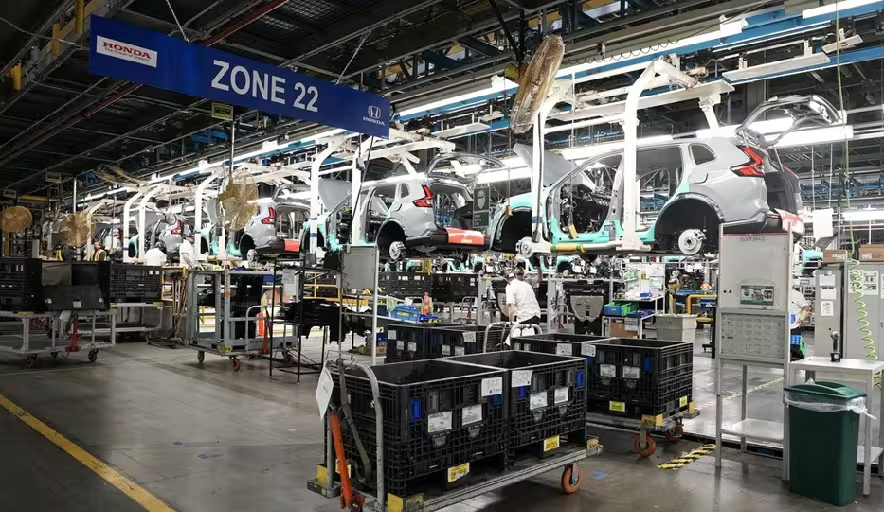
Honda’s original plan was nothing short of ambitious. The facility in Alliston, Ontario—already home to Honda’s existing assembly operations—was slated to become a fully integrated EV production hub. The scope included:
- A dedicated EV assembly line capable of producing next-generation Honda and Acura electric SUVs
- A joint-venture battery plant with a partner (widely speculated to be LG Energy Solution or a similar Korean battery maker)
- Thousands of direct jobs and thousands more in the supply chain
- Production start targeting 2028, aligning with Honda’s global goal of 100% EV sales by 2040
The investment was praised by Canadian and Ontario governments, which offered significant tax incentives and infrastructure commitments. For a time, Alliston was positioned as a flagship example of Canada’s EV manufacturing renaissance.
But that narrative has now been put on hold.
Why Now? The Three Forces Behind Honda’s Brake
Honda has not issued a detailed public explanation, but industry analysts and insiders point to three converging pressures that likely drove the decision.
1. Slowing EV Demand – The Consumer Reality Check
Global EV sales are still rising year over year, but the growth rate has decelerated sharply from the double-digit spikes of 2021–2023. Key indicators:
- Inventory glut: Unsold EVs are piling up on dealer lots in North America, forcing automakers to offer deep discounts
- Price sensitivity: Mainstream buyers remain hesitant to pay a $5,000–$10,000 premium over comparable gasoline models
- Charging infrastructure gaps: Despite federal investments, public charging networks remain unreliable and sparse in many regions
- Range anxiety persists: Cold-weather performance (especially relevant in Canada) continues to erode consumer confidence
Honda, a company known for conservative product planning, is reading the same tea leaves as Ford, GM, and Mercedes-Benz—all of which have delayed or scaled back EV production targets in recent months.
2. Tariff Turbulence – The US-Canada-Mexico Trade Wobble
The specter of trade tariffs has become a major variable for any automaker planning cross-border supply chains. Key concerns:
- Potential US tariffs on Canadian-made EVs under a possible future administration or trade dispute
- Uncertainty around the USMCA (United States-Mexico-Canada Agreement) rules of origin for battery components
- Tax credit complexities: The US Inflation Reduction Act’s EV tax credits favour vehicles assembled in the US, putting Canadian production at a competitive disadvantage
For Honda, which sells a large portion of its vehicles in the US market, committing billions to a Canadian plant while trade policy remains fluid represents a risk too large to ignore—at least for now.
3. Battery Supply Chain and Technology Evolution
Battery technology is advancing faster than factory planners anticipated. Solid-state batteries, LFP (lithium iron phosphate) chemistries, and new recycling processes are reshaping cost curves. Honda may be waiting for:
- More clarity on which battery chemistry will dominate by 2030
- Lower lithium and nickel prices to improve project economics
- Better integration with North American mineral sourcing (critical minerals deals with Canada, US, and Mexico)
Locking in a specific battery technology and factory design today could be a costly mistake if a superior, cheaper alternative emerges within two years.
What This Means for Canada’s EV Strategy
Canada has been aggressively courting EV investments, having already secured commitments from Volkswagen, Stellantis-LG, and Ford. The Honda suspension is a sobering reality check.
The Good News
- The other projects remain on track. Volkswagen’s battery plant in St. Thomas, Ontario, and Stellantis’s Windsor facility have not announced similar delays.
- Canada’s mineral wealth (lithium, nickel, graphite) remains a long-term magnet for battery investment.
- Policy stability: The federal and Ontario governments have indicated they are willing to renegotiate incentives to keep Honda interested.
The Cause for Concern
- Honda’s suspension could trigger a domino effect, with other automakers re-evaluating Canadian projects
- Labour impact: The 3,000+ construction jobs and 1,500 permanent roles that were promised are now indefinitely postponed
- Reputation risk: Canada’s image as a “sure bet” for EV manufacturing may be dented, especially if trade uncertainty persists
What Happens Next? Three Scenarios
Scenario 1: The Pause Becomes a Pivot
Honda returns to the table within 12–18 months, but with a smaller, phased investment. Instead of a massive integrated campus, they build a smaller battery plant first, then add assembly lines as demand stabilizes.
Scenario 2: The Plant Moves South
Honda redirects the investment to a US location—possibly Ohio, where they already have assembly capacity—to take advantage of US tax credits and avoid tariff exposure. This would be a significant blow to Canadian ambitions.
Scenario 3: The Suspension Becomes Permanent
If EV demand continues to soften and global overcapacity rises, Honda may never restart this specific project. They could instead rely on their existing global plants to meet North American EV demand, or partner with another manufacturer for joint production.
Expert Take: A Rational Decision, Not a Panic
“Honda is being prudent, not pessimistic,” says Dr. Elena Marchetti, an automotive industry analyst at the Center for Mobility Innovation. “They are watching the same market data everyone else is. Committing $15 billion today for a product that may not have the demand curve they anticipated in 2028 is simply not good business. The smart play is to wait, watch, and be ready to move when the conditions are clearer.”
This sentiment is echoed by suppliers who note that Honda’s pause gives them time to renegotiate long-term contracts and align with evolving battery technology.
What Should Consumers and Investors Watch For?
- Quarterly announcements: Honda’s next earnings call will likely address the suspension directly
- Canadian government response: Will Ontario offer additional incentives to keep Honda engaged?
- US trade policy: If the US-Canada tariff issue is resolved, the Alliston project could be revived quickly
- Competitor moves: If Toyota or Nissan announce new Canadian EV investments, it could pressure Honda back to the table
Final Thoughts: Not a Death Knell, but a Wake-Up Call
Honda’s indefinite suspension of the Alliston EV plant is a significant event, but it is not a funeral for Canada’s EV ambitions. It is a strategic timeout—a recognition that the industry is in a transitionary phase where demand, technology, and trade policy are all in flux.
For Honda, this is about capital discipline and long-term competitiveness. For Canada, it’s a reminder that winning EV investments requires not just incentives, but also stable trade relationships and a clear path to consumer adoption.
The race is not over. But the pace has changed. And everyone—from automakers to governments to consumers—is adjusting their speed accordingly.