From Mining to Moon: How a Canadian Company Just Revolutionized Lunar Water Purification
When humanity builds its first permanent outpost on the Moon, the most critical resource won’t be rocket fuel, oxygen, or even food—it will be water. Not water shipped from Earth at staggering cost, but water extracted from lunar soil, processed on-site, and made safe to drink.
That’s exactly what a Calgary-based engineering firm has achieved. By winning top honors in a global competition, they’ve introduced a practical solution that could redefine how humans survive beyond Earth.
Why Conventional Water Solutions Fail on the Moon
Lunar water is far from clean. Ice exists in permanently shadowed craters near the poles, but it isn’t like a frozen lake on Earth. It’s embedded in lunar regolith—a fine, abrasive dust that is electrostatically charged and contaminated with heavy metals such as chromium and mercury.
Once melted, this ice becomes a toxic slurry. Traditional solutions struggle:
- Filtration systems clog almost instantly due to fine regolith particles
- Conventional distillation consumes too much energy
- Lunar conditions—especially low gravity and long periods without sunlight—make standard methods inefficient
The challenge isn’t locating water. It’s extracting and purifying it efficiently under extreme conditions.
The Winning Solution: Vacuum Distillation with a Practical Edge
Mine-Ex Innovation approached the problem from a mining engineering perspective. Their system uses vapour compression distillation, adapted for lunar conditions.
Here’s how it works in clear engineering terms:
- Low-pressure boiling: Inside a vacuum chamber, water boils at near room temperature, reducing energy use by about 40%
- Controlled vapour separation: Vapour passes through a hydrophobic barrier that blocks contaminants before condensing
- Gravity-independent flow: Capillary action and pressure gradients replace gravity-driven processes
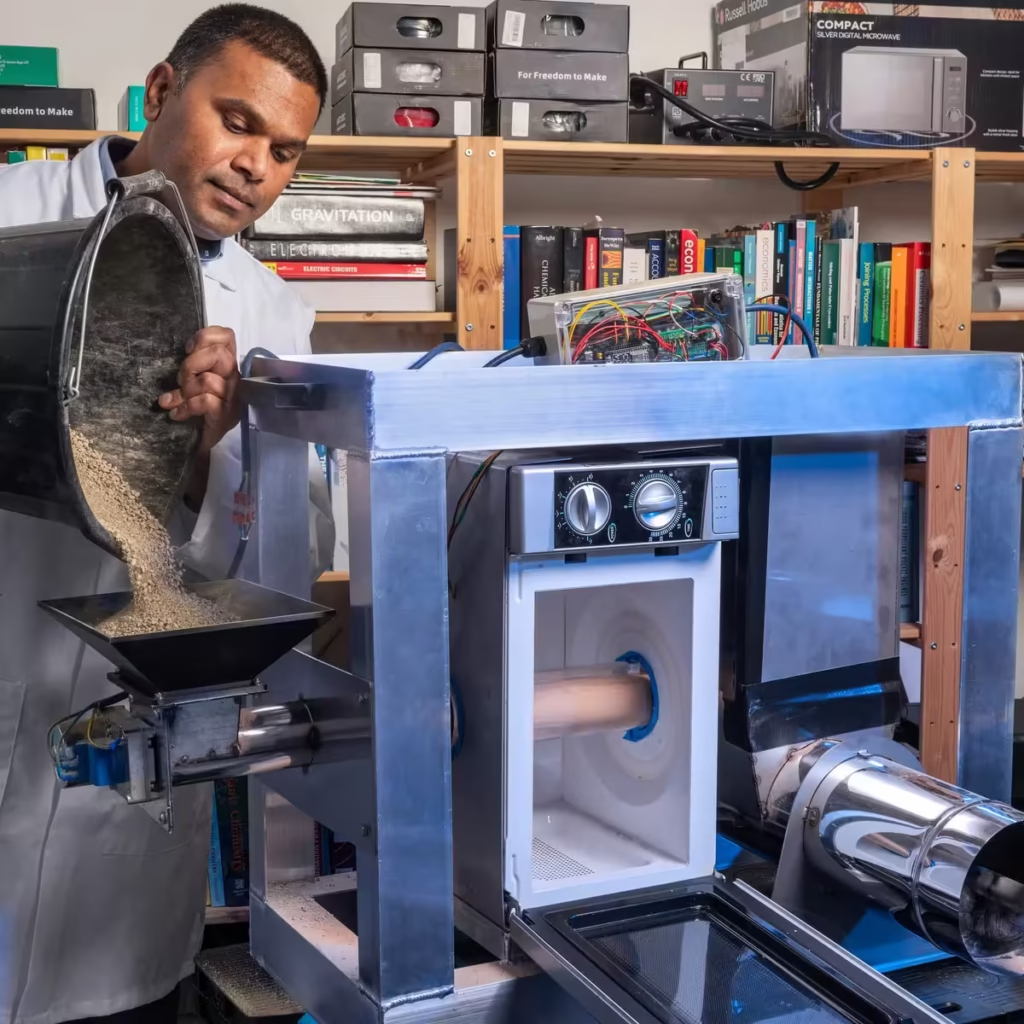
The result is a compact system capable of producing 3.5 liters of clean drinking water per hour from simulated lunar ice mixed with toxic dust. That’s enough to sustain an astronaut, with additional supply for food preparation and oxygen generation.
Why This Matters More Than It Seems
This development is more than a technical milestone—it changes how future missions can be planned.
Lower Mission Costs
Transporting water from Earth costs between $10,000 and $50,000 per kilogram. A single astronaut requires liters of water daily, quickly adding up over months. Producing water on the Moon eliminates a major logistical and financial burden.
Enabling Self-Sustaining Systems
Water can be split into hydrogen and oxygen through electrolysis. This supports:
- Breathable air
- Fuel for spacecraft
Each liter of water produced becomes a resource multiplier.
Designed for Extreme Conditions
The system handles ultra-fine dust particles—similar to those that caused issues during Apollo missions—without clogging. A self-cleaning pre-treatment stage separates solids before processing, maintaining consistent performance.
Applications Beyond Space
What makes this technology compelling is its relevance on Earth.
The same constraints—limited power, contamination, and harsh environments—exist in many real-world settings:
- Remote mining operations with heavy metal contamination
- Disaster zones where infrastructure is damaged
- Off-grid communities relying on expensive diesel-powered systems
This system runs on low energy, requires no chemical additives, and produces water that meets international drinking standards. It’s already attracting interest from industry and humanitarian groups.
What Comes Next
Following its success in the NASA Deep Space Food Challenge, Mine-Ex is moving toward real-world deployment. The next step is testing in microgravity, potentially aboard the International Space Station, before integration into future lunar missions.
The broader implication is straightforward: sustainable space exploration depends less on dramatic breakthroughs and more on reliable, efficient systems that solve fundamental problems.
A company that once tackled water challenges in mining environments is now addressing the same need on the Moon. It’s a reminder that progress in space isn’t just driven by rockets—it’s driven by practical engineering that makes survival possible.
One unit. 3.5 liters per hour. A meaningful step forward—not just for space exploration, but for how we think about water, both on Earth and beyond.