
U.S.-Born Team Canada Coach Slams Trump’s 51st State Cruelty
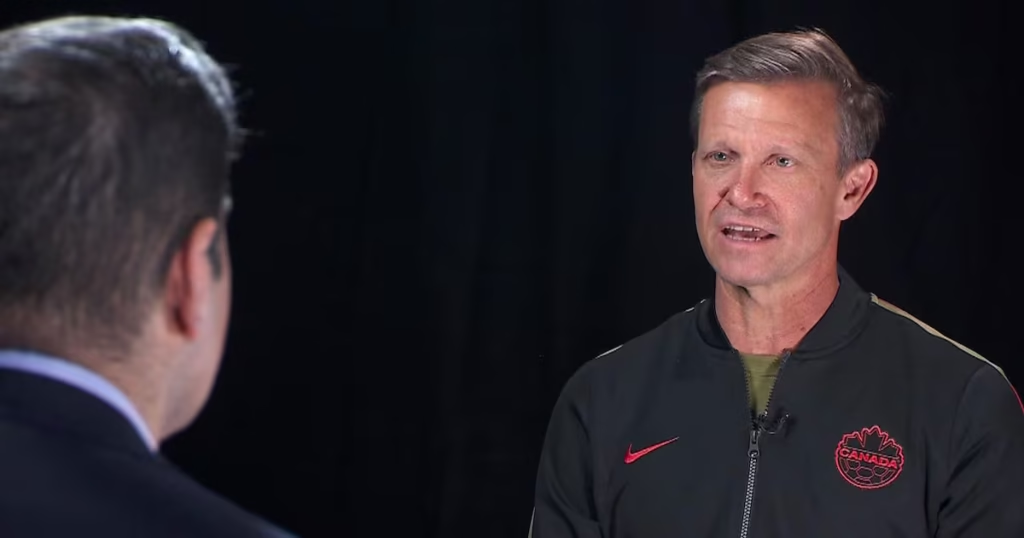
In the often-sanitized world of international sports diplomacy, where athletes and coaches typically stick to scripted sentiments about unity and competition, a powerful voice has broken through the usual platitudes. The remarks came not from a politician or a journalist, but from an unexpected figure: the U.S.-born head coach of a Canadian national team, who has publicly condemned former President Donald Trump’s recent inflammatory rhetoric about Canada.
The coach’s pointed criticism, aimed squarely at what they described as the “cruelty” inherent in Trump’s framing, has ignited a conversation that stretches far beyond the arena, touching on immigration, identity, and the increasingly blurred line between sports and political activism.
A Coach Caught Between Two Nations
The story gains its unique potency from the personal history of the individual at its center. This isn’t a lifelong Canadian criticizing a foreign political leader. This is an American who chose Canada, who now represents it at the highest level of sport, and who feels compelled to defend their adopted home from a narrative they find dehumanizing.
While the coach’s specific sport and identity were highlighted in the original broadcast, the core of the issue transcends any single game or season. It speaks to the experience of millions who cross borders, building lives and careers in new countries. For this coach, wearing the Maple Leaf is not just a job; it’s an affirmation of a chosen identity. To hear their nation of birth’s leading political figure reduce Canada to a potential trophy of conquest—a “51st state”—struck a deeply personal chord.
The “51st State” Rhetoric: More Than Just Political Hyperbole
To understand the coach’s strong reaction, one must examine the context of Trump’s statement. The phrase “51st state” is not new in U.S. political discourse, often used flippantly in reference to Canada. However, when deployed by a figure like Trump, especially within the framework of his broader “America First” platform and history of contentious remarks about allies, it takes on a more aggressive tone.
The coach zeroed in on the underlying ethos of dominance and dismissal they perceive in the language. It’s not just a joke or a geopolitical musing; it’s a negation of Canadian sovereignty, culture, and self-determination. But the coach’s condemnation went beyond sovereignty alone. The key word they used was “cruelty.”
This suggests the coach interprets the rhetoric as part of a wider pattern—a pattern they see in policies and statements directed at immigrants, marginalized communities, and nations perceived as less powerful. The cruelty, in this view, lies in the erasure of shared humanity and respect, reducing a complex, proud nation of nearly 40 million people to a simplistic political talking point.
Reactions and Ripples: Sports Enters the Political Fray
The coach’s decision to speak out has generated a cascade of reactions:
- Support from the Canadian Public: Many Canadians have applauded the coach’s willingness to defend the country’s dignity. In an era where national identity feels increasingly significant, hearing a prominent sports figure—and an American by birth, no less—articulate this defense resonates strongly.
- The Inevitable Backlash: Predictably, the comments have also drawn criticism from those who believe sports figures should “stick to sports.” Commentators and supporters of the former president have accused the coach of overstepping and importing unwanted political discourse into the apolitical realm of sport.
- Internal Team Dynamics: A critical question is the impact within Team Canada. Does this statement unify the team around a shared symbol of their national pride, or could it create friction for athletes who may hold differing political views? The coach’s leadership is now being tested in a forum far more complex than any championship game.
The Unavoidable Intersection of Sports and Politics
The incident forcefully underscores a modern reality: the idea of an apolitical sports sphere is a fantasy. Athletes and coaches are citizens with voices, platforms, and convictions. From Colin Kaepernick taking a knee to global movements for racial justice, and from Olympic gestures for peace to boycotts of events on human rights grounds, sports has always been intertwined with the social and political currents of its time.
This coach’s statement is a new variation on that theme. It’s not about a domestic U.S. issue, but about international relations and perceived disrespect between allies. It highlights how global figures in sports now operate on a stage where their words can instantly become part of transnational diplomatic and cultural conversations.
A Deeper Message on Leadership and Principle
At its heart, this story is about more than a political soundbite. It’s about leadership and moral courage. The coach made a conscious choice to step into a potential firestorm, knowing it could attract significant backlash. They prioritized a principle of respect and human dignity over the path of least resistance.
This act defines a different kind of coaching philosophy—one that extends beyond tactics and training regimens to encompass the character and values a leader projects. It asks: What do we stand for? How do we respond when something we care about is belittled? For this coach, silence was not an option.
Furthermore, it challenges the narrative of the “ungrateful immigrant.” Here is an individual who achieved success in Canada and is now using their platform to vigorously defend it, demonstrating a profound form of loyalty and gratitude through action, not just words.
Looking Ahead: The New Normal for Global Sports Figures
As the world moves toward another major electoral cycle in the United States, with global implications, this incident may be a precursor of things to come. International athletes and coaches with ties to the U.S. may feel increasing pressure to address or navigate the divisive rhetoric that often emanates from its political landscape.
The episode sets a precedent. It signals that coaches, especially those with multinational identities, may no longer remain silent on issues that directly impact their sense of self and their team’s national pride. The “cruelty” the coach identified is a powerful charge, one that frames the issue not in terms of policy wonkery, but in fundamental human terms.
In the end, a story that began with a political comment has evolved into a revealing moment about identity, allegiance, and the courage to speak one’s truth. The U.S.-born coach of Team Canada didn’t just defend a border on a map; they defended an idea—the idea that nations and their people deserve to be spoken of with respect, not reduced to pawns in a rhetoric of power. In doing so, they have reminded us that sometimes, the most powerful statements of principle don’t come from a podium in a capital city, but from the heart of someone who has chosen where they belong.

